By Abdul Rafay Afzal (Editor in Chief – The Advocate Post)
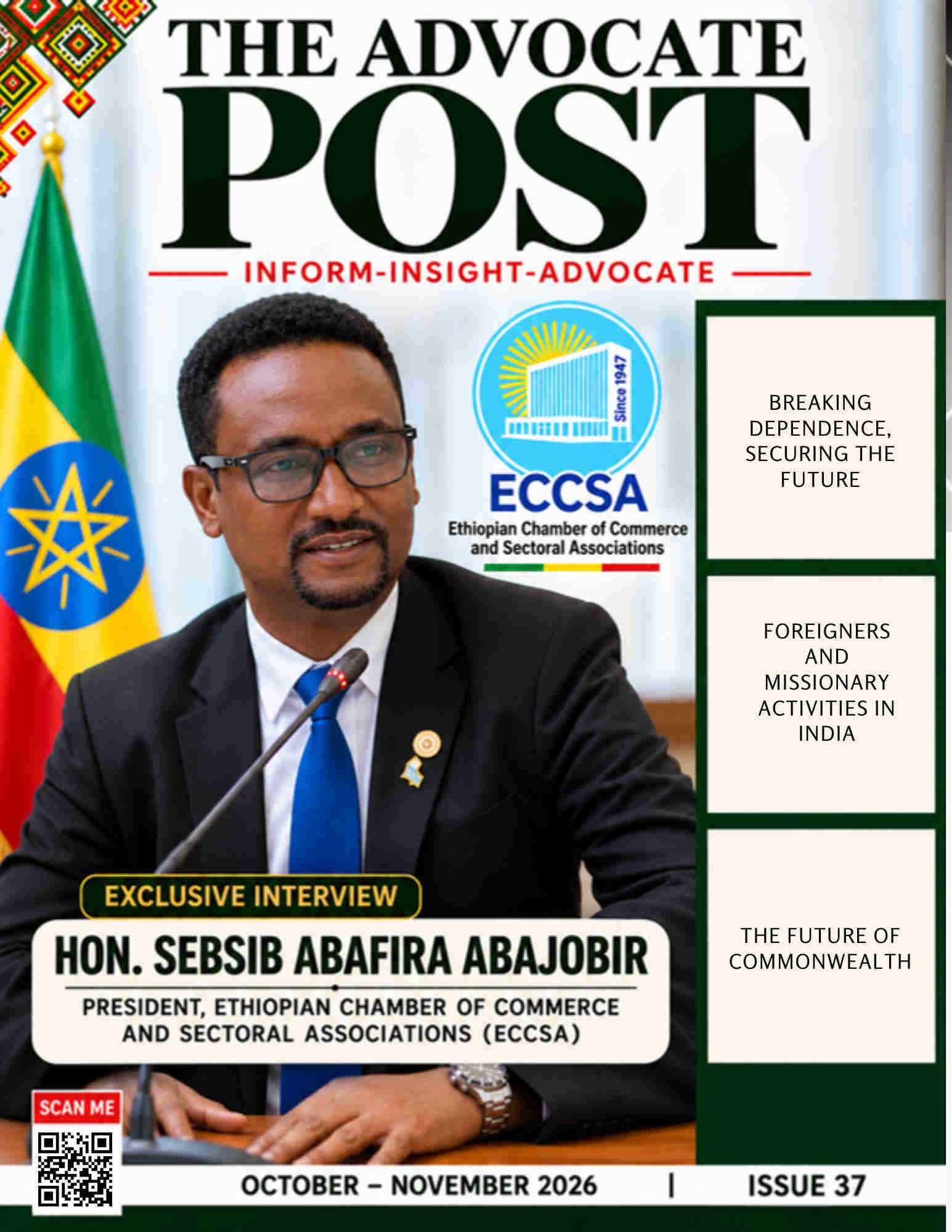
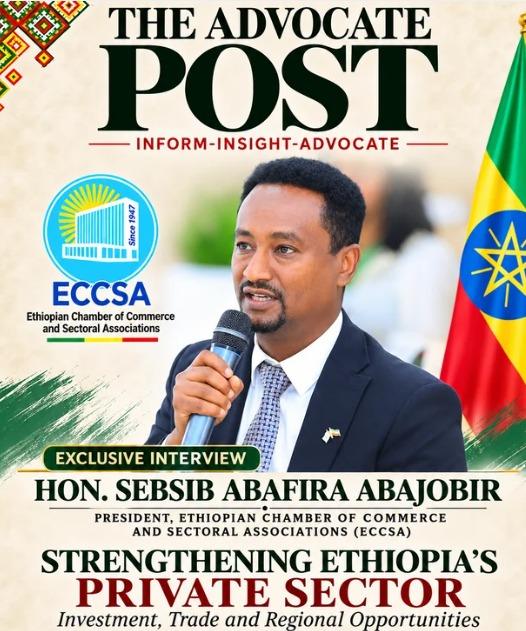
As Ethiopia advances its economic transformation, the private sector is assuming an increasingly important role in shaping the country’s development. In this exclusive interview with The Advocate Post, ECCSA President H.E. Sebsib Abafira Abajobir discusses economic reforms, international investment, regional integration and the expanding commercial opportunities across the Horn of Africa.
Q1. How has your entrepreneurial experience shaped your leadership philosophy and vision for the Chamber?
Having been directly involved in agriculture, manufacturing, import-export, real estate and services, I have developed a firsthand understanding of the opportunities and challenges facing businesses in Ethiopia.
Successful entrepreneurship requires more than capital. It demands resilience, innovation, sound management, access to markets and a supportive policy environment.
My vision is to make the Chamber an increasingly dynamic, influential and service-oriented institution that effectively represents the private sector. Ultimately, I envision a competitive, productive, innovative and export-oriented private sector that creates employment, generates wealth and contributes to national development.
Q2. How do you assess Ethiopia’s ongoing economic reforms and the challenges confronting businesses?
The Homegrown Economic Reform Programme represents a significant effort to address structural challenges, improve macroeconomic stability and expand private-sector participation.
Foreign exchange reforms, financial sector liberalisation, capital market institutions and the opening of previously restricted sectors to investment are encouraging developments.
However, businesses continue to face challenges involving affordable finance, foreign exchange availability, production costs, logistics, energy reliability, taxation and regulatory complexities.
Reform implementation must remain consistent, predictable and responsive to business realities. Economic liberalisation should create a level playing field while enabling Ethiopian enterprises to grow, modernise and compete effectively.
Q3. What are the Chamber’s principal strategic priorities under your leadership?
Our priorities centre on institutional capacity, improved member services, policy advocacy and expanding domestic and international business engagement.
We are committed to strengthening public-private dialogue, particularly regarding taxation, finance, customs, investment and industrial development.
Through business forums, trade delegations, exhibitions and strategic partnerships, we aim to transform investment opportunities into actual commercial relationships.
We will also support small and medium-sized enterprises, strengthen regional chambers and advocate for predictable regulations, fair competition and reduced bureaucratic barriers.
Our ambition is to make the Chamber not merely a representative institution, but a proactive partner in economic development.
Q4. Which sectors offer the strongest investment opportunities in Ethiopia?
Agriculture and agro-processing are among the most promising sectors, particularly coffee, horticulture, livestock, dairy and oilseeds. The real opportunity lies in moving beyond raw commodity exports towards processing, packaging and branding.
Manufacturing, including textiles, pharmaceuticals, leather products, construction materials and food processing, offers considerable potential. Mining, renewable energy, technology, tourism, financial services and logistics are equally important.
Ethiopian businesses must invest in modern technology, professional skills, quality management and internationally recognised standards.
We should aspire to make Ethiopia not simply a source of raw materials, but an important centre of competitive production and regional industrial supply chains.
Q5. How can international institutions and development partners support Ethiopia’s private sector?
International cooperation is essential to Ethiopia’s economic transformation. Our engagement with UNCTAD, the United Nations Economic Commission for Africa, the International Trade Centre, the World Trade Organization and other partners provides opportunities for technical assistance and meaningful partnerships.
We particularly value cooperation in capacity building, investment mobilisation, export development, digital commerce and sustainable business practices.
International cooperation must go beyond conferences and the signing of agreements. It should produce measurable outcomes, including technology transfer, investment commitments, market access and actual commercial partnerships.
Q6. How prepared is Ethiopia for AfCFTA integration and WTO membership?
The African Continental Free Trade Area creates significant opportunities for Ethiopian businesses to access new markets, establish partnerships and benefit from economies of scale.
Ethiopia’s efforts towards WTO accession are equally important for strengthening transparency and predictability in international trade.
However, businesses must improve productivity, financial capacity, technology and compliance with international standards.
Customs modernisation, simplified documentation, efficient border management and stronger certification institutions are essential.
Our objective must be to ensure that Ethiopian businesses are not merely participants in expanding markets but competitive producers, exporters and investors.
Q7. What should be done to strengthen cross-border trade across the Horn of Africa?
The Horn of Africa possesses enormous economic potential, but cross-border commerce remains constrained by logistics costs, customs procedures, infrastructure gaps, non-tariff barriers and financial limitations.
Governments should prioritise harmonised customs procedures, modern border facilities, digital trade documentation and improved regional payment arrangements.
Chambers of commerce must facilitate business connections, exchange market information and communicate practical obstacles to policymakers.
Our vision should be a region where geographical proximity becomes an economic advantage and borders facilitate rather than obstruct legitimate commerce.
Stronger commercial relations will contribute to employment, investment, regional stability and shared prosperity.
Q8. How important is the Berbera Corridor to Ethiopia’s commercial interests?
For Ethiopia, as a landlocked country with a growing economy, reliable and diversified access to international maritime services is of strategic importance.
The Berbera Port and Corridor represent an important opportunity to strengthen connectivity, diversify logistics options and improve supply-chain resilience.
However, physical infrastructure alone is insufficient. Reliable roads, efficient border crossings, harmonised customs procedures, transparent port charges and digital cargo-tracking systems are necessary.
Ethiopian and Somaliland businesses should be encouraged to invest in warehousing, dry ports, freight forwarding and cold-chain facilities.
The Berbera Corridor should be viewed not merely as a transport route but as an economic development corridor.
Q9. Which sectors offer immediate opportunities for Ethiopia–Somaliland business cooperation?
Livestock and related industries are among the most natural areas of cooperation. Ethiopia possesses substantial livestock resources, while Somaliland has established commercial networks and export experience.
Opportunities exist in veterinary services, animal feed, meat processing, agriculture, manufacturing, renewable energy, financial services and insurance.
However, individual commercial relationships should gradually develop into structured partnerships, joint ventures and long-term investments.
We want Ethiopian and Somaliland entrepreneurs to move beyond simply buying and selling products towards investing together, establishing businesses, sharing expertise and developing regional value chains.
Q10. What were your principal takeaways from the Somaliland Insurance Summit & Expo 2026?
My participation in the Summit in Hargeisa on 12–13 October was a valuable opportunity to explore areas of mutual interest.
Insurance is not simply a financial service; it is an important instrument for managing commercial risks, protecting investments and supporting business continuity.
I was encouraged by the attention given to regulatory development, financial inclusion, Shariah-compliant insurance and sustainable trade.
Appropriate insurance products could support livestock exports, cargo transportation, logistics and infrastructure investment.
A reliable insurance sector in Somaliland would contribute positively to investor confidence and complement the development of the Berbera Corridor.
Q11. What outcomes do you envisage from the MoU signed between the Ethiopian and Somaliland Chambers of Commerce?
The Memorandum of Understanding represents an important milestone in strengthening institutional and commercial relations.
Our immediate priority is to establish an effective implementation mechanism, identify priority sectors and develop a practical programme of joint activities.
We envisage bilateral business forums, reciprocal trade
delegations, business-to-business meetings, investment promotion and commercial information exchange.
Initial progress can be achieved through structured engagements in the near term. Larger investment projects will require proper assessment, financing and regulatory approvals.
The agreement’s success should ultimately be reflected in increased trade, investment partnerships, expanded market access and tangible benefits for businesses on both sides.
Q12. What opportunities will the 16th Ethio-Chamber International Trade Fair offer international businesses?
The Trade Fair, scheduled for 3–7 February 2027 in Addis Ababa, will bring together domestic and international manufacturers, exporters, investors and business associations.
Our ambition is to move beyond a conventional exhibition towards a comprehensive business engagement and investment promotion platform.
Priority sectors include agriculture, manufacturing, technology, infrastructure, tourism and energy.
Companies will have opportunities to identify suppliers, buyers, distributors, investors and long-term business partners.
We warmly invite the international business community, particularly businesses from Somaliland, to participate in this important event.
Q13. What is your long-term vision for Ethiopia and your message to international investors?
My vision is to see Ethiopia emerge as a more diversified, industrialised, competitive and investment-driven economy, playing a leading role in the development of the Horn of Africa.
The region should not be viewed merely as a collection of separate national markets, but as an opportunity for complementary production, cross-border investment and integrated supply chains.
We recognise that investors require predictability, transparency, efficient institutions and commercially viable opportunities.
We welcome investors interested in establishing long-term partnerships, developing productive industries, transferring technology, creating employment and contributing to sustainable economic development.
Our ambition is to build a region in which businesses can invest confidently, trade efficiently, access markets and create opportunities across borders.
EDITORIAL INSIGHT
Ethiopia’s economic transformation presents significant opportunities for private-sector growth, international investment and regional integration. In this exclusive interview, ECCSA President Sebsib Abafira Abajobir outlines a vision centred on stronger business partnerships, competitive industries and deeper commercial cooperation across the Horn of Africa.
DISCLAIMER
This feature is published for informational and editorial purposes. The views expressed are those of the interviewee and do not necessarily reflect the editorial position of The Advocate Post.
Abdul Rafay Afzal is a lawyer, international journalist, and Founder & Editor-in-Chief of The Advocate Post. He writes on geopolitics, international relations, legal affairs and public policy. He also serves as President (Youth) of the Civil Society Network Pakistan and Consultant for International Cooperation and Media Diplomacy at Lahore Press Club. He can be reached at abdulrafayafzal@theadvocatepost.org.