By Zonash Aman Ullah (United Kingdom)
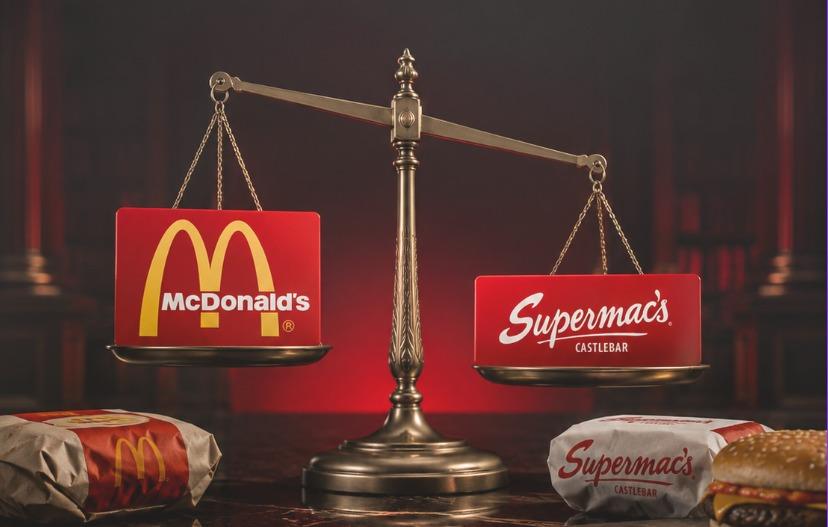
Some legal disputes reveal their wider importance only after one looks beyond the immediate parties. The long-running trademark contest between McDonald’s and the Irish fast-food chain Supermac’s is one of them. On its surface, the dispute concerns restaurant names, logos and the use of “Mac”. At its heart, however, it asks a more fundamental question: how far should the law allow a powerful brand to control ordinary elements of commercial language?
The United Kingdom Intellectual Property Office has now ruled that Supermac’s may register its name and logo in the UK. It concluded that the average consumer would not confuse the Supermac’s branding with McDonald’s trademarks, including Big Mac and McCafé, and found sufficient visual, aural and conceptual differences between them. Significantly, it also determined that consumers would not make the necessary link between the competing marks merely because they contain “Mac” or “Mc”.
That conclusion is persuasive. Trademark law exists to protect the identifying function of a brand: it enables consumers to know whose goods or services they are purchasing. It is not intended to give a company ownership of every word, prefix or syllable that happens to appear in a famous mark.
McDonald’s unquestionably possesses valuable goodwill. Big Mac is among the world’s best-known product names, and McCafé is a significant brand in its own right. The law is therefore right to protect those marks against imitation, consumer confusion, dilution and attempts to profit unfairly from their reputation. Yet strong protection must not become unlimited protection. Reputation may widen the legal shield around a trademark, but it should not convert that shield into a monopoly over language.
The proper question is not whether two marks share a fragment. It is whether, viewed as a whole and in their commercial context, their similarities are likely to mislead consumers or cause them to assume an economic connection. “Supermac’s”, “Big Mac” and “McCafé” differ in their structure, sound, appearance and overall impression. The common presence of “Mac” cannot, by itself, settle the matter. Consumers are capable of recognising those distinctions; trademark law should not proceed on the assumption that they are inattentive to every feature except a shared syllable.
The UK ruling is particularly striking because it follows a different outcome in the European Union. Only weeks earlier, the European Union Intellectual Property Office’s Board of Appeal concluded that Supermac’s branding was too close to the Big Mac trademark and that there was a likelihood of confusion among English- and German-speaking consumers. The opposing decisions do not necessarily mean that either legal system has abandoned established trademark principles. Registration rights are territorial, the evidence before each authority may differ, and consumer perception is assessed within the relevant market.
Nevertheless, the divergence exposes a serious practical problem. A business may be considered sufficiently distinct in one jurisdiction yet confusingly similar in another, even where the products, language and branding are substantially the same. Following Brexit, businesses operating across the UK and EU can no longer assume that success or failure before one trademark authority will determine the result before the other. They need separate registrations, evidence, legal strategies and litigation budgets.
For large multinational corporations, that fragmentation is costly but manageable. For smaller companies, it can determine whether expansion is commercially possible at all. Supermac’s was founded in Galway in 1978 and has developed into the Republic of Ireland’s largest Irish-owned fast-food restaurant business, yet it has spent years contesting trademark proceedings against one of the world’s most powerful corporate brands. Most small and medium-sized enterprises could not sustain such a fight.
This does not mean that opposition by a large trademark owner is automatically abusive. Businesses are entitled—and often required—to defend the distinctiveness of their brands. But the justice of a trademark system must be measured not only by the rights it recognises, but also by whether those rights can be asserted and resisted on reasonably equal terms. When the financial burden of proceedings itself becomes capable of deterring legitimate competition, legal process can begin to confer an advantage broader than the substantive law intended.
The UKIPO decision therefore matters beyond burgers. It affirms that even a globally famous corporation must establish the legal ingredients of its claim. Commercial scale cannot replace evidence of consumer confusion or a legally meaningful association between marks. Nor should a smaller business lose the right to develop its own identity merely because part of its name resembles part of a famous brand.
At the same time, Supermac’s UK registration should not be misunderstood as permission to imitate McDonald’s presentation, trade dress or individual registered marks. The decision protects a sufficiently distinct brand; it does not weaken the general prohibition against misleading consumers. That distinction is exactly why the ruling strikes the right balance.
Trademark law works best when it protects both goodwill and competition: famous businesses must be able to defend the identities they have built, while new and smaller businesses must remain free to use language in genuinely distinctive ways. McDonald’s is entitled to the full protection of Big Mac and McCafé. It should not, however, be entitled to every commercial road that happens to pass through “Mac”.
The UKIPO’s ruling is therefore more than a victory for Supermac’s. It is a reminder that intellectual property rights are instruments of fair competition, not barriers against it. A famous trademark deserves a strong shield—but not ownership of the alphabet.