
By Meerab Suhaib (Pakistan)
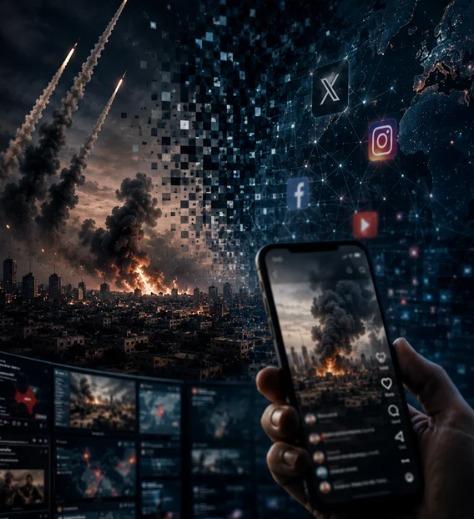
Throughout history, the news of the war reached the public through newspapers, radio broadcasts, and carefully edited television reports. However, today, conflicts unfold on social media platforms like X, Instagram, and Facebook. They are unfolded through the circulation of graphic content, emotional testimonials, and sensitive battlefield footage. This content reaches millions of people before experts can even provide them with an understanding of its context.
Thus, this new digital environment relies heavily on algorithms rather than editors deciding which perspective of the war the world should see. As a result, a new kind of battlefield has been created where public perception is shaped not by ground reality, but by invisible systems that determine what will be viral. In this landscape, the understanding of the war is no longer shaped solely by journalists, rather they are increasingly determined by algorithms that millions of people see online.
With the rise of social media platforms, the reporting of wars has been dramatically transformed. Unlike traditional journalism, which relied on editorial oversight and verification before release, today conflicts unfold instantly on these social media platforms. Thus, within minutes, audio and video from the battleground start to circulate among millions that still hold to be a fragmented part of the actual context.
The idea that war can become detached from reality is not new. During the Gulf War of 1991, philosopher Jean Baudrillard argued that the conflict was experienced largely through televised images, missile-camera footage, and highly controlled broadcasts specifically from the US perspective. According to his view, war adapted a form of “hyperreality,” where the simulation of war replaced its reality for audiences. Thus, viewers experienced a cinematic and controlled version of the conflict.
This pattern is also recurrent with the ongoing Iran War (2026), which began with large-scale strikes on Iran by the US-Israeli forces. The conflict led to hundreds of casualties, mass displacement, and disruption to travel and oil supplies. From the onset of the conflict, social media has been cluttered with graphically sensitive videos of missile strikes, air defense interceptions, and civilian evacuations. While this can bring global attention to unfolding events, it also means that audiences usually encounter fragments of the war rather than the broader political context necessary to understand global politics.
The growing influence of these social media platforms on the Iran-Israel war suggests that this conflict is increasingly being shaped by viral content rather than verified news. These algorithms actively construct content through prioritizing sensitive and graphical images and videos to maximize watch time, clicks, and shares. In turn, the audiences are exposed to dramatic moments of war that lack proper facts regarding the political and historical context of the conflict.
This is clearly evident by the recent developments in the Iran-Israel war. As a response to the coalition attack on Iran by the US and Israel, Iran has started to conduct missile and drone attacks on US bases in the Middle East. The emotionally charged videos from these sites quickly spread across social media, without any official confirmations.
This significantly leads to the issue of the circulation of misinformation. During the escalation, some viral clips and images were flagged as either outdated or unrelated to the current conflict, yet they play a vital role in shaping the initial perceptions of the war. Research from the Massachusetts Institute of Technology (MIT News) confirms that false information tends to spread 70 percent faster than real stories, thus increasing the likelihood that misinformation influences public conscience even before the facts are established. As a result, public opinion in the conflict is increasingly vulnerable to manipulation by viral moments rather than by comprehensive analysis.
Despite these risks, social media is playing a significant role in creating awareness on the civil impact of the Iran-Israel war. The videos from the civilian areas have struck considerable global attention towards the humanitarian crisis, such as mass displacement, destruction, lack of healthcare, and massive casualties as a consequence of the war. This visibility has helped mobilize forces such as the UN for swift humanitarian responses and increase international awareness.
However, this can lead political actors to utilize such vulnerable moments to create opportunities for amplifying narratives to support their propaganda. As all versions of the information compete simultaneously on these platforms, the audiences may struggle to distinguish the verified information from misleading, emotionally charged information.
Therefore, the current Iran-Israel conflict illustrates that modern-day warfare is not contained to the battlefield; it spreads across multiple digital platforms. Although on one side, these platforms have given more visibility to these issues, they also make the public vulnerable to distortion, as the conflict’s risks are analyzed by viral images rather than informed debates.
Thereafter, as wars continue to unfold in real time, there is an increasingly urgent need for responsible media consumption. For the global audiences to understand these conflicts outside the digital world, it is significant to promote stronger verification systems, improved media literacy, and transparency in social media platforms.
Author is a Student of Law at University of Essex.



This Post Has 3 Comments
Such a unique take on modern warfare and its relationship with digital media. Not many people have highlighted this, kudos!
Pingback: Shock on the Social Media Stage: How Viral Trends Amplify Headlines
Pingback: Multani Ceramics, Kashi Gari and Vegan Camel Skin Lamps: Reinterpretation of Heritage Craft - The Advocate Post