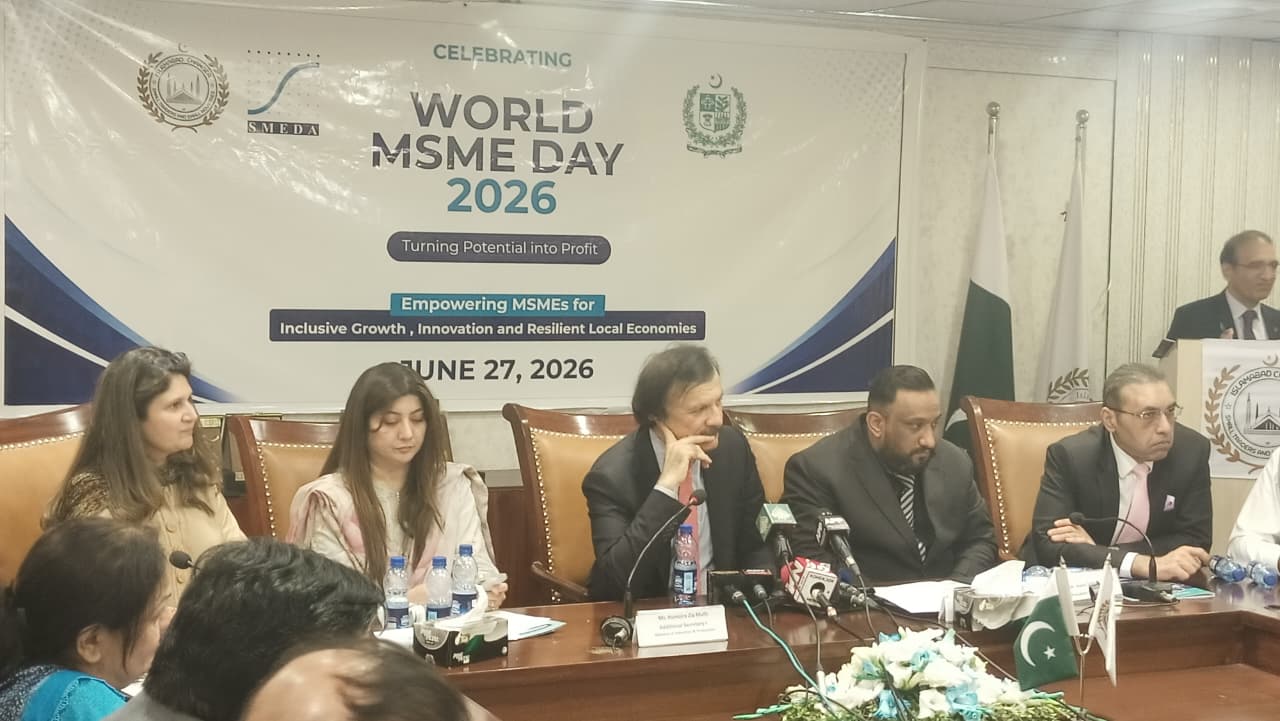
ISLAMABAD, June 27, 2026: The Government of Pakistan has reaffirmed its commitment to supporting Micro, Small and Medium Enterprises as a central pillar of national economic growth, with Special Assistant to the Prime Minister for Industries and Production, Haroon Akhtar Khan, stating that MSMEs have assumed a vital role in strengthening the economy amid challenging conditions.
Speaking as keynote speaker at an interactive session held on World MSME Day 2026, SAPM Haroon Akhtar Khan said the government is extending maximum support to MSMEs through improved access to finance, business formalization, capacity-building initiatives, and market access opportunities.
The session was hosted by the Small and Medium Enterprises Development Authority at the Islamabad Chamber of Small Traders and Small Industries to promote dialogue, networking, and outreach among MSMEs seeking government support. A documentary highlighting SMEDA’s major initiatives was also screened during the event.
Haroon Akhtar Khan said MSME development remains at the heart of the government’s economic agenda under the leadership of Prime Minister Muhammad Shehbaz Sharif.
“Access to credit remains one of our foremost priorities, with encouraging growth in lending by banks and microfinance institutions,” he said.
Citing State Bank of Pakistan data, the SAPM said Pakistan’s SME financing portfolio had surged to Rs. 853.94 billion as of March 31, 2026, compared to Rs. 584.44 billion on March 31, 2025, reflecting an impressive growth of 46 percent. He added that the number of SME borrowers had increased from 203,139 to 312,355 during the same period, marking a rise of 53.7 percent.
He further stated that the government is committed to supporting women entrepreneurs and microenterprises, particularly in underserved regions, to build a vibrant, inclusive, and globally competitive MSME ecosystem.
Highlighting international and institutional collaborations, Haroon Akhtar Khan said the government’s partnerships with Alibaba, JICA, the Pakistan Institute of Fashion and Design, and microfinance institutions are designed to help MSMEs access wider markets and strengthen their competitiveness.
“The government’s aim is the enduring prosperity of our MSMEs,” he said.
Speaking on the occasion, SMEDA Chief Executive Officer Nadia Jahangir Seth said World MSME Day provides an important opportunity to recognize the resilience, innovation, and contribution of millions of Pakistani entrepreneurs to the national economy.
She said SMEDA, under a renewed vision and strategic direction set by the Ministry of Industries and Production and its Board of Directors, is implementing a robust three-year Business Plan aimed at making MSMEs more bankable, digitally equipped, export-ready, and globally connected.
She highlighted several SMEDA initiatives, including free business registration through the SME Registration Portal, export readiness programs, inter-firm linkages, climate-focused initiatives, the SME Certification and International Accreditation Grant Programme, and a five-year project to convert banana waste into eco-friendly textile.
In line with Prime Minister Shehbaz Sharif’s vision of inclusive economic growth, she said SMEDA is reaching out to women-led and microenterprises to provide digital and financial literacy, product development support, export readiness training, market access opportunities, B2B linkages, and value chain integration.
Nadia Jahangir Seth said SMEDA remains committed to creating an enabling environment where enterprises can become more competitive, bankable, and internationally connected.
Islamabad Chamber of Small Traders and Small Industries President Awais Satti welcomed the government’s renewed focus on MSME development and appreciated the initiatives being undertaken through SMEDA. He said stronger public-private collaboration, improved access to finance, and broader market linkages are essential for unlocking the true potential of Pakistan’s MSME sector.
World MSME Day is observed globally on June 27 to recognize the contribution of micro, small, and medium enterprises to employment generation, innovation, and sustainable economic growth.
This year, SMEDA organized interactive sessions and discussions in Islamabad, Rawalpindi, Lahore, Faisalabad, Gujranwala, Gujrat, Sialkot, Multan, Sargodha, Abbottabad, Hyderabad, Dadu, Sukkur, and Mirpur.
In Lahore, SMEDA, in collaboration with the Lahore Chamber of Commerce and Industry, organized a stakeholder engagement session. LCCI President Faheem Ur Rehman Saigol attended the session as chief guest and emphasized the importance of entrepreneurship and enterprise development in strengthening Pakistan’s economy.
He appreciated the role of MSMEs in creating employment opportunities, promoting innovation, and advancing inclusive economic growth.
Muhammad Javed Afzal, Regional Chief Central at SMEDA, briefed participants on SMEDA’s mandate, services, and ongoing initiatives for MSME development. The session also enabled participants to share recommendations for improving the business environment and enhancing the competitiveness of local enterprises.