
By Justice (R) Markandey Katju (India)
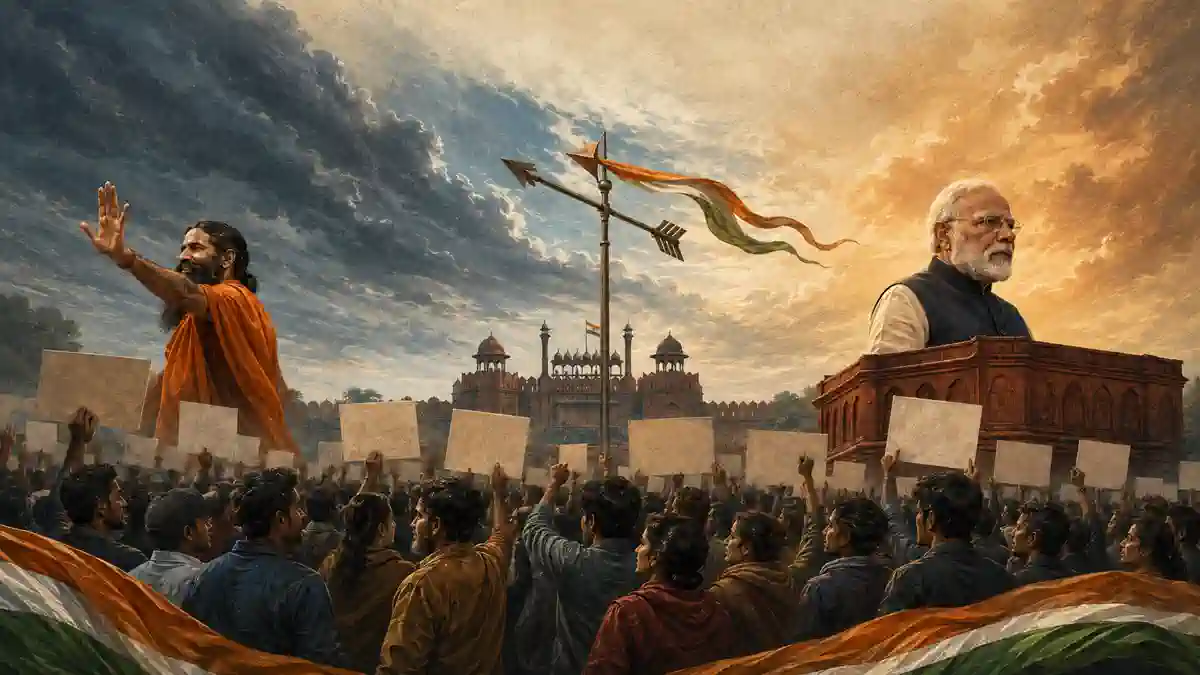
Baba Ramdev, the yoga guru who was until recently a staunch supporter of Prime Minister Narendra Modi, has performed a remarkable political somersault. In a sharp reversal, he has publicly criticised the conditions prevailing in India under Modi’s rule.
In a recent speech, Ramdev said that there is hungaama—hue and cry—everywhere in India. Schoolchildren complain that their schools have no teachers, electricity, water or toilets. Where teachers are present, textbooks are unavailable. Examinations are marred by cheating and question-paper leaks, while, according to him, selections for government jobs are afflicted by 90 percent corruption. Ramdev described these conditions as being contrary to democracy and justice.
His intervention came soon after Prime Minister Modi’s Independence Day address from the Red Fort in Delhi. In that speech, Modi launched a fierce attack on his critics, describing them as dimaaghi Naxals, or “mental terrorists”. He repeatedly highlighted the achievements of his government—including developments in the semiconductor sector—citing statistic after statistic and proclaiming that India would become a prosperous nation by 2047.
Modi also criticised much of what was done in India before he came to power in 2014. In doing so, he appeared to forget the foundations laid by the government of former Prime Minister Jawaharlal Nehru. It was under Nehru that India established major heavy industries, including steel plants; founded engineering institutions such as the Indian Institutes of Technology; expanded schools and colleges throughout the country; promoted education for girls; abolished the zamindari landlord system; and introduced important social reforms.
These reforms included the Hindu Marriage Act 1955, which prohibited polygamy among Hindus, and the Hindu Succession Act 1956, which recognised daughters’ rights in their deceased fathers’ property.
Despite Modi’s claims of extraordinary economic progress, India ranks 130th out of 193 countries on the Human Development Index. This ranking exposes the enormous distance between official claims of growth and the lived reality of ordinary Indians.
Even if we accept the statistics claiming substantial GDP growth under Modi’s rule—and we must remember the famous aphorism attributed to Mark Twain about “lies, damned lies, and statistics”—a more important question remains: who is receiving the fruits of this alleged growth? Are they reaching the Indian masses, or are they being cornered by a handful of powerful businessmen such as Ambani and Adani?
I have addressed this question repeatedly in my earlier writings, including “Lies, Damned Lies and Statistics in India”, “The Truth Behind India’s Explosive GDP Growth”, “There Are Two Indias in India” and “The Truth About the Indian Economy”.
The scale of inequality is staggering. Nine individuals in India have been reported to own wealth equivalent to that of the poorest half of the country’s 1.43 billion people. What meaning does economic growth have for the masses when its benefits are concentrated in so few hands?
Around 80 percent of India’s population is Hindu, and the Bharatiya Janata Party claims to represent Hindu interests. This appeal enabled it to win election after election, both to Parliament and to numerous state legislatures.
But conditions now appear to be changing, and the political wind in India seems to be shifting direction.
Indian youth are increasingly rising above communalism and casteism and demanding employment. This was visible during the recent protests at Jantar Mantar in Delhi, where young people came together across religious and caste divisions.
Religion may have its place, but one cannot eat religion. People need food, and to obtain food they need employment. India, however, is confronting record and rising unemployment. At the same time, the prices of food and other essential commodities are soaring.
The country continues to face appalling levels of child malnutrition. Every second Indian child is reportedly malnourished, and India’s position in the Global Hunger Index has deteriorated from 101st to 107th among the 125 countries surveyed. Proper healthcare and quality education remain beyond the reach of much of the population.
These realities explain why public discontent is boiling over. The Modi government, which has governed India for 12 years while facing little effective political opposition, now appears to be on the back foot.
The most significant opposition is not coming from established political parties. It is emerging from the people themselves—from citizens who are fed up with prevailing conditions, tired of being misled by empty rhetoric and increasingly determined to demand tangible improvement in their lives.
This is also why political weathercocks such as Baba Ramdev, who were previously among Modi’s strongest supporters, are now changing their tune. They can sense that the wind is moving in another direction.
I am reminded of the following verses by the Urdu poet Akbar Allahabadi:
Khabar deti hai tehreek-e-hawa tabdeel-e-mausam ki,
Khilenge aur hi gul, zamzame bulbul ke kam honge.
Badal jaayega meyaar-e-sharaafat chashm-e-duniya mein,
Zyaada the jo apne zom mein, woh sab se kam honge.
In English:
The movement of the wind indicates a change of season.
Other flowers will now bloom, and the songs of the bulbul will diminish.
The world’s understanding of rectitude will change,
And those once consumed by pride and arrogance will fall to the lowest position.
Napoleon reportedly said of China: “China is a sleeping giant. Let her sleep, for when she awakes, she will shake the world.”
He could have said the same about India.
India is the sleeping giant—and it is waking up now.



This Post Has One Comment
Very well analysed.tbe writing is on the wall.
Hope the establishment does not wear them out.