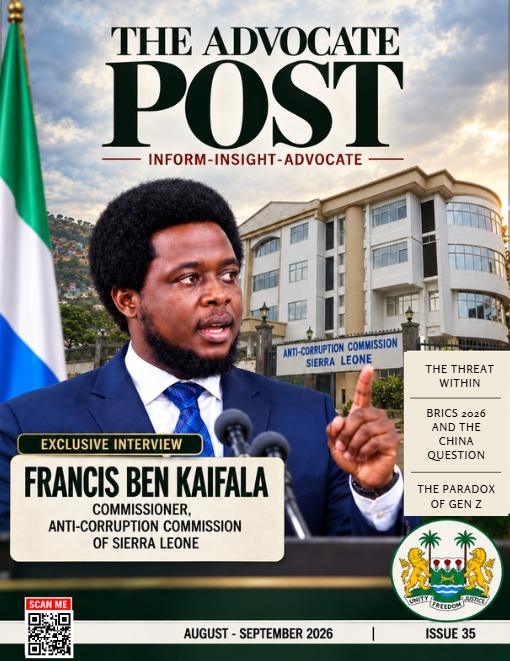

From Enforcement to Public Trust: Francis Ben Kaifala on Sierra Leone’s Fight Against Corruption
The Advocate Post Exclusive Interview by Abdul Rafay Afzal (Editor in Chief – The Advocate Post)
Francis Ben Kaifala, Esq.
Commissioner, Anti-Corruption Commission of Sierra Leone
From public education and asset recovery to artificial intelligence, extractive-sector governance and the growing security implications of corruption across West Africa, Sierra Leone’s anti-corruption architecture is confronting challenges that extend well beyond prosecutions.
In an exclusive interview with The Advocate Post by Abdul Rafay Afzal (Editor in Chief of The Advocate Post), Francis Ben Kaifala, Commissioner of Sierra Leone’s Anti-Corruption Commission, discusses the philosophy that has shaped the Commission during his tenure, the difficulties involved in investigating powerful individuals, the next stage of the country’s digital asset-declaration system, corruption in frontline public services, vulnerabilities in the extractive sector, and why regional cooperation must become a more serious part of Africa’s anti-corruption response.
He also reflects on the balance between recovering stolen assets and prosecuting offenders, the potential role of artificial intelligence in corruption detection, and what he wants the Commission to look like when his tenure eventually concludes.
Interview by Abdul Rafay Afzal, Editor-in-Chief, The Advocate Post
Q1. Looking back at your tenure since 2018, what have you learned about fighting corruption? And if you had to define the “Sierra Leone model” of anti-corruption, what would be its three defining characteristics?
Francis Ben Kaifala: What our experience has shown is that the fight against corruption cannot depend on enforcement alone. Over this period, public education has improved, prevention strategies have improved, and these have worked together with enforcement to create a stronger governance architecture. That is also translating into improvements in the indicators by which our performance is assessed. But we continue to push the fight against corruption very strongly.
If I had to define our model, I would say that it rests on three pillars.
The first is public education. We undertake rigorous public education and engage people across different media. It is important not only to encourage citizens to support the fight against corruption, but also to educate them about what corruption actually is. Many people do not necessarily have a clear understanding of all its manifestations or implications.
The second pillar is prevention. Prevention is perhaps the strongest part of the fight against corruption, although it is usually not the part that attracts the most public excitement because it is less dramatic than an investigation or prosecution. But prevention is what changes systems. You introduce policies, strategies and institutional mechanisms that improve how governance is conducted and reduce the opportunity for corruption before it happens.
The third pillar is enforcement. That includes investigations and prosecutions.
These pillars: public education, prevention and enforcement, have to work together. That, essentially, is the model.
Q2. Sierra Leone has performed strongly on some international anti-corruption indicators, while other measures, including perception-based indices, continue to show substantial room for improvement. How should these apparently different pictures be understood? And what should Sierra Leoneans expect to see by the end of the current National Anti-Corruption Strategy in 2028?
Kaifala: Corruption is difficult to measure. There have been discussions even at the international level about how we arrive at an appropriate methodology for measuring it because corruption can mean different things to different people and in different contexts, even though there are areas where we broadly agree.
Most of the measurements that are used are perception-based, and a lot of things can influence perception. Politics within a country can influence it. Economic conditions can influence it. Many variables can affect how people perceive corruption.
So, while these indices are imperfect and may not always present the exact picture on the ground, we still need them. They provide parameters through which we can assess whether progress is being made.
There can also be a difference between public perception and what is happening at the broader institutional level. A citizen may see a police officer on the street taking money from a driver and conclude that corruption is everywhere. That experience is very real to that person. But the Commission may simultaneously be addressing corruption at a much larger systemic level.
People are naturally more conscious of the corruption they experience in their daily lives.
By 2028, we expect the strategy we are currently implementing to have become much more firmly established. One of its important elements is the increased use of technology in fighting corruption and improving our capacity for detection and prevention.
We expect that progress to continue, both in the indicators and, importantly, in the reality experienced on the ground.
Q3. Can the Anti-Corruption Commission investigate politically powerful or well-connected individuals without fear or favour? What makes investigations involving people in positions of power particularly difficult?
Kaifala: Definitely, the Commission has the power to investigate people in positions of power without fear or favour.
But there is a practical difficulty that comes with power. When someone remains in a powerful position, obtaining evidence against that person can sometimes become more difficult if the surrounding system does not cooperate.
For example, if you are investigating a minister, people working under that minister may be reluctant to provide evidence. There may also be difficulty accessing certain information. As long as the individual remains in that position, these factors can make an investigation more complicated.
The public may then conclude that the Commission does not want to act against that person, or that somebody is preventing the Commission from acting. That can create a perception of political interference even where the underlying problem is one of evidence, access or cooperation.
Ultimately, fighting corruption requires courage from the people leading anti-corruption institutions. It also requires a strong legal and institutional framework around them.
There is always the possibility of political retaliation when powerful interests are confronted. That comes with the responsibility of holding this type of office. You have to do what the law requires, do it properly, and navigate those realities carefully.
Q4. Citizens frequently hear about findings contained in public audit reports but may hear much less about what eventually happened. Could the ACC establish a mechanism publicly tracking referrals, investigations, recoveries, prosecutions and cases closed for insufficient evidence?
Kaifala: We actually had such a mechanism.
If you go back through the Commission’s work, you will see that we investigated matters arising from public audit reports and informed the public about what we had done — what had been investigated, what had been found, whether somebody had been charged, whether money had been recovered, or whether a matter had been dealt with administratively.
That continued until the issue arose concerning the constitutional role of Parliament in relation to the Auditor-General’s reports.
Parliament took the position that the Commission could not simply proceed with the Auditor-General’s report independently because the Constitution provides a role for Parliament in debating and acting upon those reports.
That significantly affected the approach we had previously taken.
So the type of public accountability mechanism you are describing is not foreign to us. We had been doing it, and the public appreciated being able to see what happened after issues were identified in the audit process. The difficulty has been the constitutional and institutional question surrounding how those reports should subsequently be handled.
Q5. The digital asset-declaration system has become an important reform. But filing a declaration is only the first step. How far is the ACC moving towards verification, lifestyle audits and eventually greater public disclosure?
Kaifala: We designed the reform in phases.
Phase one was moving from a paper-based system to a digital system. We have achieved that completely.
Phase two was driving compliance with the digital declaration system, and we have also made substantial progress there.
We are now moving into phase three, which is verification. That involves the type of work you have described: examining declarations more closely, conducting lifestyle-related verification and checking whether what has been declared corresponds with the information available to us.
That phase is beginning in 2026.
Phase four would be to pursue reform towards public declaration of assets.
At present, however, the law contains confidentiality provisions governing asset declarations. Changing that would require legislative reform.
For now, declarations can be used by the Commission in its work, including investigations and appropriate court proceedings, but we cannot simply make those declarations available to the public under the existing legal framework.
So there is a progression. We have moved from paper to digital declarations, then towards stronger compliance, we are now entering verification, and the longer-term question is whether the law should eventually permit an appropriate degree of public disclosure.
Q6. Grand corruption receives considerable attention, but ordinary citizens often experience corruption through small unofficial payments in police stations, hospitals, licensing offices and other public services. How do you tackle that everyday form of corruption?
Kaifala: Our enforcement work is primarily concentrated on grand corruption, although there are instances involving petty corruption where enforcement action can have a wider deterrent effect.
But when dealing with everyday or petty corruption, one of our major strategies is public education.
Public education addresses both sides of the problem — demand and supply. Citizens have to understand that they should not participate in corrupt transactions. They need to report corruption and be willing to support the fight through their own actions.
The second important strategy is prevention.
For example, where there is too much direct cash interaction between officials and members of the public, we encourage systems that reduce that contact and make transactions more digital or cashless. When you reduce unnecessary direct interaction, you can reduce opportunities for corrupt payments.
So for petty corruption, public education and prevention are extremely important. For grand corruption, enforcement, investigation and prosecution assume a much greater role.
Q7. You have publicly argued that the ACC cannot itself take charge of Sierra Leone’s examinations. What institutional reforms are required to protect the integrity of examinations and prevent malpractice from becoming normalised?
Kaifala: The institutions that are actually responsible for examinations have to take greater responsibility.
The Ministry must have clear policies, guidelines and enforcement mechanisms. Schools must have proper supervision. Teachers, principals and administrators have to recognise that the integrity of examinations is fundamental.
The Anti-Corruption Commission has approximately 300 staff serving the entire country. It would simply not be realistic for the Commission to take responsibility for supervising thousands of examination centres.
What we can do is act in serious and blatant cases. Where the evidence warrants it, we investigate and prosecute. We also continue with public awareness and prevention work.
But primary responsibility has to remain with those institutions that administer and regulate examinations — including the Ministry, the West African Examinations Council, schools and school administrators.
We have also developed cooperation arrangements with relevant institutions. We work with the Police, the Ministry, the West African Examinations Council and organisations representing school principals and teachers.
Coordination is important. The ACC has a role to play, but we should not become the primary institution responsible for running or policing examinations. That is not our mandate.
Q8. The recovery of misappropriated Freetown City Council funds raised wider questions about municipal financial controls. Beyond the individuals involved, what institutional weaknesses did that case expose?
Kaifala: It exposed weak infrastructure, weak governance systems, weak supervision and weak accountability structures.
When all those weaknesses exist simultaneously, there is very little standing in the way of somebody who wants to divert public money.
That is the fundamental institutional lesson.
Similar vulnerabilities can exist elsewhere as well. The difference may simply be one of scale. Freetown has significantly greater resources than smaller councils, so the consequences can be correspondingly larger.
The broader issue is that the governance architecture, supervision and accountability systems have to be strengthened so that the system itself makes misappropriation more difficult.
Q9. Sierra Leone possesses substantial mineral resources. What are the principal corruption risks you see in the extractive industries, and what reforms are necessary to reduce opportunities for rent-seeking and opaque decision-making?
Kaifala: One of the problems we see is excessive concentration of power within the system.
When too much decision-making authority is concentrated in one individual or one institution, that creates corruption risks.
For example, decisions around licences should not depend excessively upon a single decision-maker. Authority should be sufficiently distributed so that decisions are scrutinised and arrived at institutionally rather than by one person.
There are also areas where processes can be opaque. Citizens need to be able to understand the rules: What are the requirements for obtaining a licence? How are decisions made? Is the relevant information properly published and accessible?
Those are areas that need reform.
We need to reduce monopolies and concentrations of decision-making power. We need more institutional decision-making, clearer procedures and considerably greater accountability.
There must also be greater openness around contracting and the arrangements governing the extractive sector.
Natural resources can be tremendously important to a country’s development, but that makes strong governance and accountability around those resources even more important.
Q10. The Commission has already digitised asset declarations. Can technology now be taken further into procurement, taxation, customs, licensing and public payments? And what role do you see for artificial intelligence and data analytics?
Kaifala: We have already started using artificial intelligence to analyse tax data for accountability purposes.
It has been very helpful. Work that could previously have taken investigators a very long time can now be assisted significantly through artificial intelligence.
So I consider this extremely important, and we intend to continue developing its use in the fight against corruption.
I am also going to Oxford in November to study AI in leadership and the ethical deployment of artificial intelligence. It is important that, as we expand these technologies, we understand how to use them properly and responsibly.
Our anti-corruption strategy already anticipates greater reliance on technology in fighting corruption rather than depending exclusively upon human capacity.
We are therefore going to see considerably greater use of data analytics, artificial intelligence and other technological mechanisms in anti-corruption work.
That is the direction in which the world is moving, and anti-corruption institutions need to understand how to use these tools effectively while ensuring that their deployment is responsible.
Q11. Your tenure has placed considerable emphasis on recovering stolen assets alongside criminal prosecution. Critics might argue that settlements could allow wealthy offenders to avoid criminal consequences. How do you decide when recovery is appropriate and when prosecution is necessary?
Kaifala: That is a very important question because asset recovery has been a significant part of my approach.
I strongly believe that going after the asset can sometimes be even more important than simply going after the individual. But we try to do both. We have prosecutions and convictions, and we also pursue assets very strongly.
The reality is that criminal prosecution requires proof beyond reasonable doubt. There are circumstances where the available evidence may not make prosecution the most effective option.
You also have to consider the length and cost of litigation. A case may continue for three, four, five or more years. At the end of that process, the eventual penalty may be limited, while the State has already spent substantial resources pursuing the case.
In circumstances where millions can be recovered for the country, there are cases where recovering those assets may produce a better outcome for the public.
But there must be a balance.
There are cases where prosecution is absolutely necessary because imprisonment and criminal punishment are required for deterrence. The objective must be to make corruption a high-risk, low-return activity.
For that to happen, the sanctions imposed by the justice system also have to create meaningful deterrence.
Where prosecution is appropriate, we prosecute. But where recovering assets can return substantial resources to the country and produce a stronger practical outcome, asset recovery should not be dismissed simply because it is less punitive.
The key is achieving the right balance between punishment, deterrence, recovery and protecting the public interest.
Q12. You have described corruption as a wider threat to security and democratic stability in West Africa. Are governments underestimating the danger, and what kind of regional anti-corruption architecture is now needed?
Kaifala: Corruption is a security threat everywhere.
It undermines the rule of law. It undermines people’s confidence in institutions. And when confidence in institutions deteriorates sufficiently, corruption can contribute to political unrest and instability.
West Africa therefore needs much greater emphasis on harmonised strategies across the region.
There also has to be stronger support for anti-corruption institutions and greater accountability where governments are falling behind.
One problem is that we continue to approach corruption predominantly as a national issue when corruption itself crosses borders.
If corruption takes place in one country, the proceeds, individuals or networks involved may easily move into neighbouring countries. Countries such as Sierra Leone, Liberia and Guinea are geographically and socially interconnected. Corruption does not stop at a border crossing.
Corruption is borderless, and our response therefore has to become more collective.
West Africa needs greater urgency, stronger cooperation and more coordinated action. We should spend less time arguing about how the region is characterised in international assessments and more time recognising the problem and taking action to address it.
Our response has to become more deliberate and more regional.
Q13. How open is the ACC to partnerships beyond West Africa — including institutional twinning, staff exchanges, joint training, digital asset-declaration cooperation, universities, research institutions and technical agreements? And, finally, what would you like your institutional legacy to be?
Kaifala: We are very open to those partnerships, and we are already engaged in many of them.
We have twinning arrangements and training relationships with institutions in Africa and other countries. We have cooperation agreements, and we work with a range of institutions, including universities and researchers.
So expanding that type of institution-to-institution cooperation is something we would very much welcome.
Anti-corruption challenges are increasingly international. Knowledge, technology, asset-recovery expertise and institutional experience can be shared, and there is considerable value in building those relationships.
As I eventually come towards the end of my role at the Anti-Corruption Commission of Sierra Leone, I want to be able to look back and say that I did my best and that the institution is stronger than when I came.
There are three things I would particularly like to see.
First, I want the Anti-Corruption Commission to be stronger institutionally and more independent, so that its effectiveness does not depend upon the personality of whoever happens to lead it.
Second, I want the prevalence of corruption in Sierra Leone to be reduced to a very minimal level.
And third, I want Sierra Leone to have moved substantially forward in its standing on Transparency International’s Corruption Perceptions Index and other measures of anti-corruption progress.
If those things are achieved, then I would be comfortable knowing that we have built something that can continue beyond one Commissioner or one administration.
About the Interviewer: Abdul Rafay Afzal is a lawyer, international journalist, and Founder & Editor-in-Chief of The Advocate Post. He writes on geopolitics, international relations, legal affairs and public policy. He also serves as President (Youth) of the Civil Society Network Pakistan and Consultant for International Cooperation and Media Diplomacy at Lahore Press Club. He can be reached at abdulrafayafzal@theadvocatepost.org.
Disclaimer:
The views expressed in this interview are those of the interviewee and do not necessarily reflect the editorial position of The Advocate Post. Historical references and personal recollections have been presented as shared by the interviewee.
Editorial Insight:
Kaifala’s interview underscores a broader lesson in anti-corruption governance: enforcement alone is insufficient without prevention, public education, institutional independence and stronger systems of accountability. Sierra Leone’s evolving approach from digital asset declarations and asset recovery to the use of artificial intelligence and greater regional cooperation reflects an attempt to move anti-corruption policy beyond individual prosecutions towards structural reform. The real measure of success, however, will be whether these reforms become sufficiently institutionalised to outlast personalities, political cycles and individual office-holders, while producing changes that citizens can actually experience in their everyday interaction with the state.
The Advocate Post
Exclusive Interviews | Global Affairs | Law | Governance | Policy & Diplomacy