
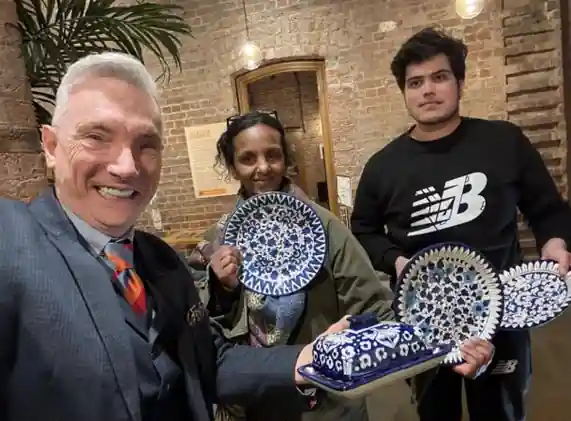
The Advocate Post: Multani ceramics occupy a distinctive place in Pakistan’s artistic and cultural heritage. Known for their floral patterns, geometric balance, and luminous shades of turquoise, cobalt blue and white, these works are more than decorative objects. They represent a living craft tradition shaped by centuries of movement, exchange, adaptation and regional refinement.
The history of Multani ceramics is often understood through a wider civilisational journey. Influences associated with China, Persia and Iran travelled across artistic and commercial routes before becoming embedded in the visual language of the subcontinent. In Multan, these influences developed into a recognisable ceramic identity: one defined by disciplined line work, glazed surfaces, floral rhythm and architectural geometry.
Within this tradition, the work of exhibition designer and heritage artist Nauman Mirza offers an important contemporary case study. His research-led practice explores how endangered craft knowledge can be preserved, reinterpreted and presented to modern international audiences without reducing it to nostalgia or commercial repetition.
The Living Heritage of Multani Ceramics
Multani blue pottery and Kashi Gari are often admired for their surface beauty, but their deeper significance lies in the technical discipline behind the finished object. Every vessel, panel and decorative form depends on a sequence of skilled decisions: clay preparation, shaping, drying, patterning, glazing, kiln control and final finishing.
Nauman Mirza’s work makes this process visible. Rather than presenting heritage craft as a static relic of the past, he treats it as a system of knowledge. His practice shows that traditional ceramics are not merely handmade products; they are the result of training, repetition, observation and intellectual discipline.
This approach is especially important at a time when many heritage skills are threatened by mass production, declining apprenticeship systems and reduced public understanding of craft labour. Mirza’s work responds to this challenge by placing the maker’s process at the centre of the exhibition experience.
The Ustad-Shagird Tradition
Mirza’s artistic formation is deeply connected to the historical studio culture of Multan. His training was not inherited as a finished identity, but developed through the discipline of the Ustad-Shagird model, a traditional system of fine-art pedagogy based on close observation, spatial precision, and material refinement. His early development began with controlled motif geometry, gradually advancing through the master lineage associated with the legacy of Ustad Muhammad Wajid. His practice later matured within the his own environment, where he moved beyond technical execution toward material research, sustainable innovation, and gallery-based fine-art installation. This heritage remains visible in the precision of his line, the balance of his non-functional sculptural compositions, and the controlled rhythm of his surfaces. The Ustad-Shagird tradition is not merely a biographical detail in Mirza’s work, it serves as the structural foundation of his contemporary visual arts language.
From Commercial Craft to Contemporary Installation
One of the strongest aspects of Mirza’s practice is his movement away from conventional commercial production. While Multani ceramics are often reproduced for decorative and tourist markets, Mirza uses the same heritage vocabulary to create more sophisticated contemporary installations.
As an exhibition designer, he controls light, space, placement and viewing angle. These decisions are not secondary to the artwork. They shape how the viewer encounters the physical presence of the ceramic object, the handmade surface and the structural form.
This allows the audience to slow down and examine the details that are often overlooked: the density of the line, the relationship between pattern and form, the balance between negative space and ornament, and the interaction between glaze and light.
In this sense, Mirza does not simply display Multani ceramics. He frames them as contemporary heritage objects with artistic, cultural and intellectual value.
The Architectural Quality of Kashi Gari
The critique of Mirza’s work centres on his ability to translate inherited motifs into refined contemporary product thinking. His hand-thrown vessels and ceramic panels demonstrate careful colour balance, rhythmic repetition and compositional control.
The floral and geometric surfaces do not feel random or purely ornamental. They appear architectural. Each line contributes to a larger visual structure. Each repeated motif participates in a disciplined system of proportion and rhythm.
This is where Mirza’s work becomes particularly relevant for international audiences. He does not merely reproduce Kashi Gari as a regional craft. He studies its internal grammar and adapts it into a modern design language that can function within galleries, cultural institutions, exhibitions and high-end heritage installations.
Vegan Camel Skin Lamps and Ethical Material Innovation
A defining feature of Mirza’s recent practice is his engagement with vegan alternatives to traditional camel skin lamps. Camel skin lamps have long been associated with Multan’s visual culture, but contemporary audiences increasingly ask difficult questions about ethics, sustainability and animal welfare.
Mirza responds to this concern through cruelty-free vegan skin alternatives that preserve the visual memory of the traditional lamp while rethinking the material assumptions behind it. These works are significant because they show that heritage can evolve without losing its cultural identity.
The result is not a rejection of tradition. It is a responsible adaptation of tradition.
By introducing vegan camel skin lamp alternatives, Mirza expands the conversation around Pakistani heritage craft. He demonstrates that traditional forms can remain relevant when they respond to contemporary ethical expectations. This gives the work a stronger place within global discussions on sustainable design, material innovation and cultural preservation.
Process as Intellectual Property
Another important dimension of Mirza’s work is his commitment to process transparency. He presents documentation of ceramic body preparation, sun-drying, glazing behaviour, kiln discipline and firing outcomes alongside the finished objects.
This approach challenges the romantic mystification that often surrounds handmade craft. Instead of treating the completed object as a mysterious artefact, Mirza reveals the full chain of decisions behind it.
Clay selection, drying time, pigment density, hand movement, glaze behaviour and kiln temperature all become part of the artwork’s intellectual structure. The exhibition therefore becomes an extension of the workshop classroom.
This is a powerful curatorial decision. It positions craft knowledge as intellectual property and cultural capital. It argues that heritage skills should not be preserved only as sentimental memory. They should be recognised as complex systems of design intelligence, material science and artistic authorship.
Preserving Heritage for International Audiences
Mirza’s practice is important because it offers a practical model for the future of endangered craft traditions. His work does not freeze heritage in the past. It allows tradition to move, adapt and communicate with new audiences.
Installations provide a clear entry point into the sophistication of Multani ceramics and Kashi Gari. For local audiences, they reaffirm the value of workshop knowledge, apprenticeship and handmade discipline. For cultural institutions, they demonstrate how heritage craft can be displayed with seriousness, dignity and contemporary relevance.
In a global art environment often dominated by speed, spectacle and digital reproduction, Mirza’s work insists on the value of the handmade line. It reminds the viewer that craft is not slow because it is outdated. It is slow because it is precise.
Frequently Asked Questions
What are Multani ceramics?
Multani ceramics are a traditional form of pottery and decorative craft associated with Multan, Pakistan. They are recognised for floral and geometric patterns, glazed surfaces and shades of blue, turquoise and white.
What is Kashi Gari?
Kashi Gari refers to a traditional style of decorative ceramic and tile work often associated with glazed surfaces, intricate patterns and architectural ornamentation.
What are vegan camel skin lamps?
Vegan camel skin lamps are cruelty-free alternatives to traditional camel skin lamps. They preserve the visual character of the heritage object while avoiding the use of animal skin.