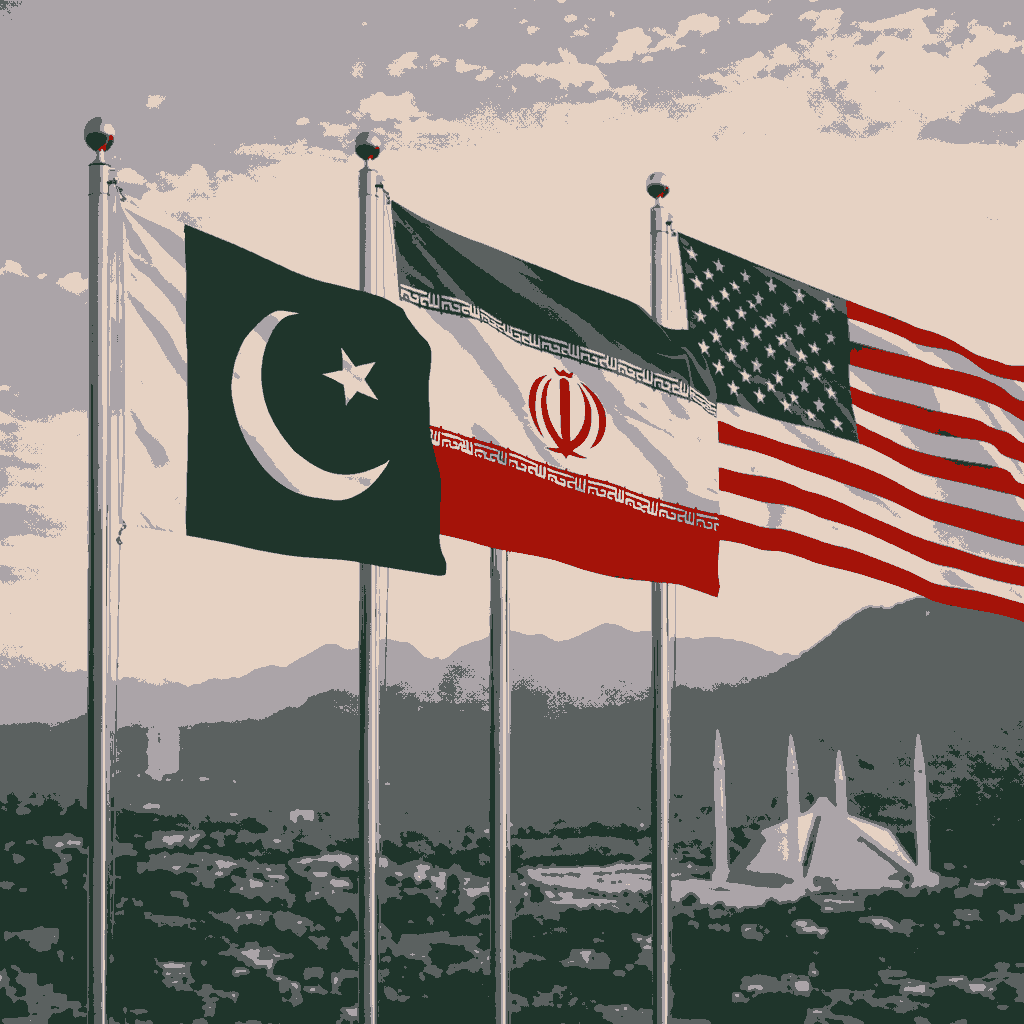
Islamabad: Pakistan has emerged at the centre of a major diplomatic push in the Middle East after helping secure a two-week ceasefire between the United States and Iran, a breakthrough that has temporarily paused a six-week war but has not yet delivered a durable peace. The truce, announced on April 8, was brokered by Pakistan and is now being tested by deep mistrust, competing political demands, and continuing violence elsewhere in the region.
The ceasefire has offered a brief opening for diplomacy, but its stability remains uncertain. Reuters reported that even after the truce was announced, fighting connected to the wider regional conflict continued, especially in Lebanon, where Israel launched major strikes against Hezbollah. Iran, meanwhile, signalled that it was reconsidering the logic of immediate negotiations under such conditions, arguing that developments on the ground had already undermined confidence in the agreement. U.S. officials have said Washington halted its attacks on Iran for now, but also made clear that military operations could resume if the effort to reach a broader settlement collapses.
Islamabad is now preparing to host what could become the first formal U.S.-Iran peace talks since the war began. An Iranian delegation was expected in the Pakistani capital on Thursday night, while the U.S. delegation, reportedly led by Vice President JD Vance, was due on Friday ahead of talks expected on Saturday. Pakistani authorities have imposed extraordinary security measures around key diplomatic locations in Islamabad, underscoring both the importance of the moment and the risks involved in hosting such a high-stakes negotiation.
The urgency of these talks extends far beyond the battlefield. Despite the ceasefire, shipping traffic through the Strait of Hormuz remained at well below 10% of normal levels on April 9, according to Reuters, as Iran continued to assert control over passage through one of the world’s most critical energy chokepoints. Oil markets have reacted sharply to the disruption, and although prices eased after the truce announcement, they remain significantly above pre-war levels. The state of Hormuz has therefore become a central test of whether the ceasefire can evolve into a credible framework for regional stabilisation.
For Pakistan, the mediation effort represents both an opportunity and a gamble. Reuters reported that Prime Minister Shehbaz Sharif and Army Chief Field Marshal Asim Munir were deeply involved in the diplomacy that brought Tehran back to the table after talks appeared close to collapse. Analysts cited by Reuters say Pakistan has gained unusual access and credibility with both Washington and Tehran, but they also caution that Islamabad may lack the leverage needed to force substantive concessions if the two sides remain far apart on core issues such as sanctions, regional conflict, nuclear enrichment, and freedom of navigation in Hormuz.
Pakistan’s role may also expand beyond the bilateral U.S.-Iran file. Pakistani officials said Lebanon’s Prime Minister Nawaf Salam sought Islamabad’s support for an immediate end to attacks on Lebanon, while Reuters reported that Pakistan is also trying to ensure the wider regional crisis does not engulf neighbouring states or derail the peace process before it properly begins. That places Islamabad in the unusual position of not merely hosting talks, but attempting to shape a broader diplomatic off-ramp for a conflict that has already shaken energy markets and regional security.
The international community is now watching closely. A U.N. envoy visited Tehran on April 9 as part of ongoing efforts to support a peaceful settlement and was also expected to travel to Pakistan, reflecting the growing recognition of Islamabad’s role in the current mediation track. Whether Pakistan can transform a fragile ceasefire into a sustainable political process remains uncertain. What is clear, however, is that the country has positioned itself as a consequential diplomatic actor at a moment when the region is searching for an exit from war.