
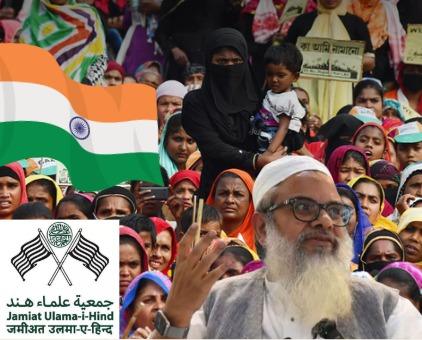
The outrage surrounding Maulana Mahmood Madani, President of Jamiat Ulama-i-Hind challenging the credibility of Indias judiciary week revealed the ruling BJPs strong disregard for dissent. When Maulana Mahmood Madani, president of the Jamiat Ulama-i-Hind raised doubts, about the integrity of Indias judiciary week the ruling BJP labeled his remarks as “divisive” and dismissed them. Yet what he said in Bhopal captures a much deeper and increasingly undeniable truth: India’s democratic institutions are undergoing a structural transformation one that threatens the delicate pluralism upon which the republic was constructed.
Madani’s criticism was not rhetorical outrage. It arose out of a place of accumulated public frustration. From the Babri Masjid verdict to a series of politically sensitive decisions that seemed to be just closely aligned to the preferences of the government, judicial independence, many Indians feel, is slowly being eroded. The judiciary, if at one time regarded as the “sentinel on the qui vive,” in many cases, risks coming to be seen as a silent spectator to executive overreach.
The courts are envisaged by India’s Constitution as the ultimate guardian of fundamental rights and a bulwark against majoritarian excess. But as Madani noted, public confidence has declined. A court that seems unwilling to keep power in check, particularly when minorities are under scrutiny cannot be meaningfully called “supreme.”
This is the nub of the current crisis. The issue is not only whether verdicts are right or wrong but whether the public perceives the judiciary as being fair, fearless and independent. When perceptions change so drastically that citizens think courts are functioning under the influence of politics, democracy gets onto dangerous terrain.
The larger picture of Madani’s comments explains why tensions have risen so dramatically. Over the last decade, civil society organizations, rights defenders and independent observers have documented a disturbing pattern of targeted actions against Muslims: mob lynchings that have been justified by communal propaganda, the use of bulldozers to demolish properties without due process, economic boycotts, arbitrary arrests using terrorism laws, and attacks against Waqf properties. Equally worrying is the systematic demonisation of madrassas and Islamic institutions which are suspect by default.
These developments are not isolated incidents. They are part of a coordinated ecosystem of political messaging, administrative action and cultural narratives, which are focused on changing the social hierarchy in India. The project is clear: to normalise the supremacy of one group whilst making minorities legally vulnerable, socially marginalised and economically insecure.
The judiciary should have provided the firewall against such trends. Instead, critics argue that it is tending to follow majoritarian impulses. High-profile cases on matters of hate speech, cow vigilantism, illegal demolition or discriminatory laws often remain pending or are treated with a level of deference to the executive that is incompatible with constitutionalism.
One is forced to concede that India’s courts do have principled judges in them who uphold rights courageously. But institutional independence is not a measure of individual judgments, it is a measure of the system’s capacity to resist the pressure of politicians. Today that ability seems to be weakening.
The BJP’s rebuttal to Madani represents another troubling change, the attempt to delegitimise criticism itself. Branding is concerned with institutional capture because “communal tension” is a rhetorical strategy aimed at silencing dissent rather than discussing the substance of the allegation. In a healthy democracy questioning institutions is not sedition, it is citizenship.
What is at stake here is beyond partisan politics. India’s world famous image as the world’s largest democracy is not just down to elections. It depends on the separation of powers, equality before the law and safety of minorities. If any of these erodes, India runs the risk of moving towards a majoritarian order which is incompatible with its constitutional founding.
One agrees with Madani or not, his warning requires reflection. When a community of more than 200 million people are feeling they are being legally cornered and socially targeted, the only appropriate response is introspection, not denial.
India stands at a crossroads. It can continue down the path in which institutions align themselves with political power, in which dissent is stigmatised and in which minorities are pushed to the margins. Or it can reaffirm the republic’s fundamental promise that justice is sight blind to faith, caste or vote bank and every citizen majority or minority is equal before the law.
The judiciary cannot afford to come across as an arm of the government. Its legitimacy is its one armour. And, once lost, it may take generations to restore.
Madani might not be the most comfortable messenger for some, but the message is clear, India has to choose between being a constitutional democracy and merely a procedural democracy.



This Post Has One Comment
Pingback: Exploring the Quasi Judicial Character of Family Courts in Pakistan - The Advocate Post