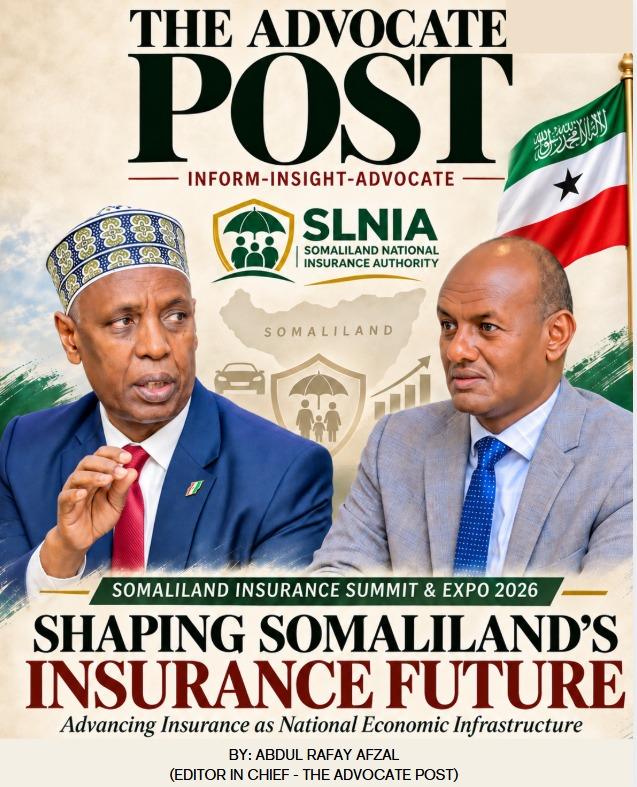
By Abdul Rafay Afzal (Editor in Chief – The Advocate Post)
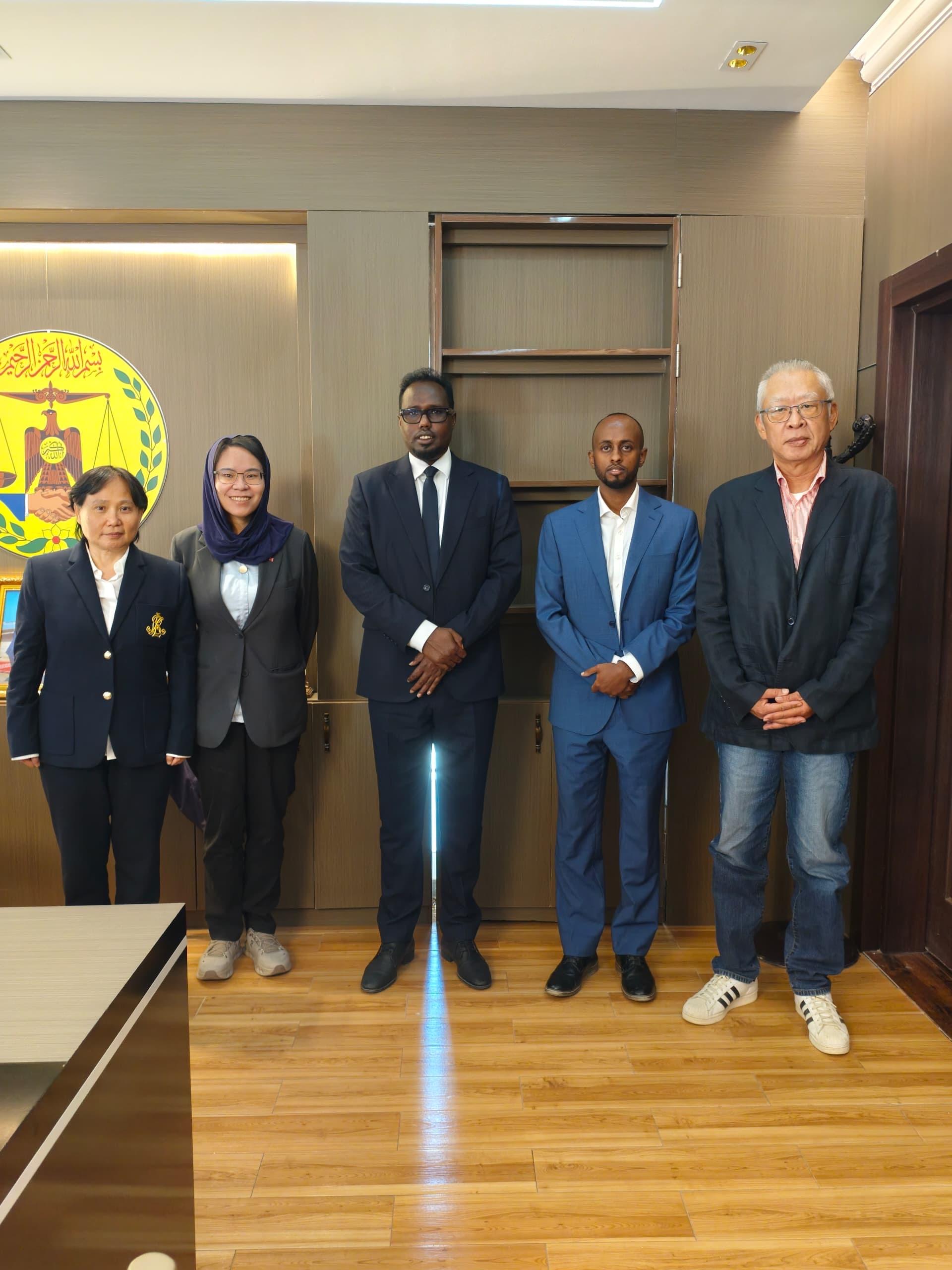
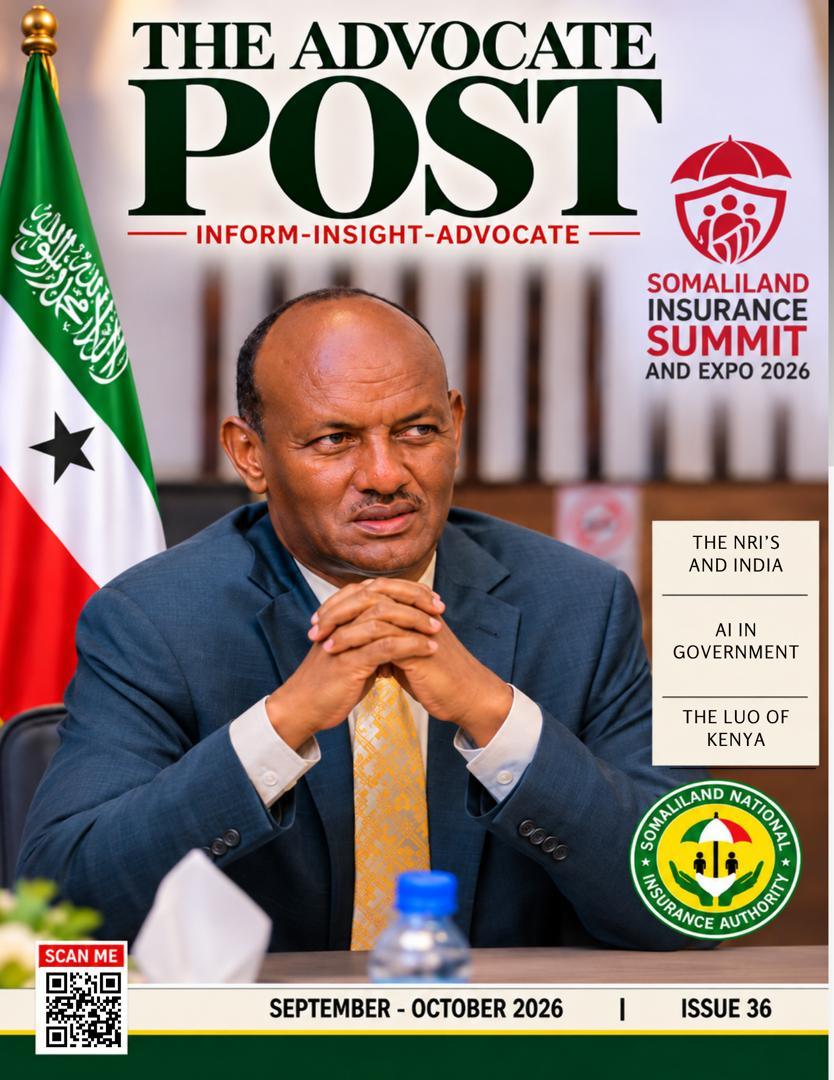
t the invitation of the Somaliland National Insurance Authority (SLNIA), Abdul Rafay Afzal, Editor-in-Chief of The Advocate Post, undertook an official visit to Somaliland to attend the historic Somaliland Insurance Summit & Expo 2026. Held at Hargeisa’s Damal Hotel on 12–13 October, the landmark gathering welcomed distinguished delegates and participants from more than ten countries, alongside senior government officials, international business leaders, insurance executives, financial experts and development professionals. More than a conventional conference, the Summit represented an important milestone in Somaliland’s ambition to establish a modern, internationally connected and financially resilient insurance industry.
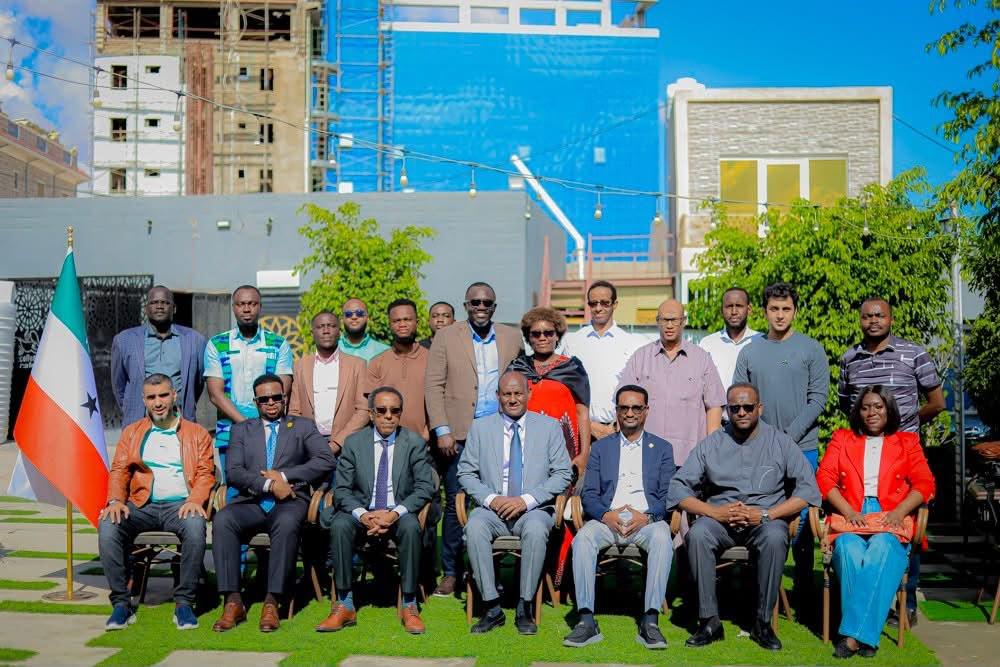
The gathering attracted international participation from Ghana, Kenya, Ethiopia, Pakistan, the United Kingdom, the United States, Cyprus, South Sudan, Djibouti, France, and Benin, among others. Their presence demonstrated growing international professional interest in Somaliland’s emerging financial sector and created opportunities for knowledge exchange, institutional partnerships and commercial cooperation. Participation took place in individual and institutional capacities, rather than necessarily constituting formal government representation.
NATIONAL LEADERSHIP AND A HISTORIC PRESIDENTIAL ANNOUNCEMENT
The Summit was formally inaugurated by H.E. Mohamed Ali Aw Abdi, Vice-President and Acting President of Somaliland, whose participation reflected the importance attached to insurance-sector development at the highest levels of government.
The proceedings brought together Finance and Economic Development Minister Abdillahi Hassan Adan, Bank of Somaliland Governor Abdinasir Ahmed Hirsi, Deputy Governor Bank of Somaliland Hamse Khaire, Energy and Minerals Minister Ahmed Jama Barre, Transport and Road Development Minister Osman Ibrahim Nuur, Religious Affairs Minister Sheikh Abdillahi Dahir Bashe and several other cabinet ministers and senior officials. International journalist Raage Omaar moderated major sessions, bringing additional international prominence to the gathering.
Perhaps the most consequential development was the presidential announcement that compulsory third-party motor vehicle insurance would commence nationwide on 1 January 2027, with all government vehicles required to obtain insurance coverage by 31 January 2027.
The announcement marked a decisive transition from legislative preparation towards practical implementation. By requiring financial protection against third-party motor liabilities, Somaliland aims to reduce the devastating economic consequences of road accidents, strengthen public accountability and establish more predictable compensation mechanisms for affected families.
THE AUTHORITY LEADING THE TRANSFORMATION
At the forefront of this ambitious agenda stands the Somaliland National Insurance Authority, chaired by Hon. Ahmed Hersi Duale, alongside Vice-Chairman Abdirashid Suleiman Mohamed and Director-General Abdisalan Mohamed Mohamoud.
Throughout the Summit, Chairman Duale emphasised the importance of building public trust, improving regulatory standards and ensuring that insurance becomes accessible to ordinary citizens rather than remaining a specialised financial product.
His central message was clear: insurance must protect lives, livelihoods, property and investments while operating through transparent institutions and accountable market practices.
The Authority’s vision goes beyond compulsory insurance. It seeks to establish a comprehensive national risk-protection system capable of supporting Somaliland’s economic transformation, attracting responsible investment and strengthening financial stability.
FROM TRADITIONAL COMPENSATION TO MODERN INSURANCE
One of the Summit’s most compelling discussions examined Somaliland’s transition “From Mag to Modernity”, exploring how customary compensation mechanisms can coexist with contemporary financial protection.
Traditionally, communities have relied on collective arrangements to address liabilities arising from death, injuries and other misfortunes. However, expanding commercial activity, increasing vehicle ownership and growing infrastructure investments require more structured and sustainable arrangements.
A properly regulated insurance system can complement traditional solidarity by distributing risks more effectively, protecting vulnerable households and creating dependable mechanisms for compensating victims.
The implications extend well beyond individual policyholders, potentially strengthening confidence among investors, employers, financial institutions and international trading partners.
BUILDING A MODERN LEGAL AND REGULATORY FRAMEWORK
Somaliland’s insurance transformation rests on the National Insurance Authority Act, Law No. 92/2020, and the Insurance Companies Act, Law No. 104. To strengthen regulatory oversight, the Authority has undertaken extensive work on eight major regulatory instruments covering licensing and corporate governance, insurance pricing and premiums, microinsurance, insurance intermediaries, prudential requirements and reinsurance, policyholder compensation, health insurance, and general accident and occupational safety insurance.
Alongside these instruments, work has advanced on a proposed National Insurance Policy, a Five-Year Strategic Plan for 2026–2030, Shariah governance arrangements and supervisory guidance.
These initiatives, supported by technical and policy contributions from professionals including Abdirahman Ismail, Lucy Wagoro and Abdul Rafay Afzal, represent significant institutional groundwork. However, draft regulations remain subject to the required legal approval and commencement procedures before becoming enforceable.
A defining feature of Somaliland’s approach is its commitment to Shariah-compliant Takaful insurance, ensuring that financial protection develops in accordance with Islamic principles while incorporating internationally recognised standards of regulation, transparency and consumer protection.
INTERNATIONAL EXPERTISE, INVESTMENT AND STRATEGIC PARTNERSHIPS
The Summit provided an important platform for international regulatory engagement and private-sector cooperation.
Among the prominent international participants was Justice Peprah Agyei of Ghana’s National Insurance Commission, representing Commissioner of Insurance Dr. Abiba Zakariah. His participation facilitated valuable exchanges on insurance supervision, institutional development and market regulation.
Other notable contributors included Dr. Hassan Bashir, Executive Director of AIID-AFRICA; Dan Sless, Managing Director of Meridian Global; and senior representatives from Ethiopian commercial institutions and regional insurance businesses.
Kenya-based Umma Insurance Brokers, alongside One World Impact, contributed sponsorship support to the gathering, reflecting private-sector interest in Somaliland’s developing insurance market.
Importantly, the Summit also produced tangible economic cooperation.
On its second day, the Ethiopian Chamber of Commerce and Sectoral Associations and the Somaliland Chamber of Commerce, Industry and Agriculture signed a Memorandum of Understanding to strengthen trade relations, investment promotion, business exchanges and institutional collaboration.
The agreement demonstrated the Summit’s wider significance as a platform connecting insurance development with regional commerce and international investment opportunities.
SLNIA has additionally reported expressions of interest and preliminary cooperation arrangements involving international insurance and reinsurance firms. Such developments offer promising opportunities for market growth, although any eventual operations must satisfy applicable licensing and regulatory requirements.
PROTECTING TRADE, WORKERS AND VULNERABLE COMMUNITIES
Beyond motor insurance, the Summit examined the increasingly important relationship between insurance, trade and national development.
Discussions addressed protection for cargo and commercial activity along the Berbera trade corridor, occupational risks in construction, mining and energy, health insurance, agricultural resilience and climate-related losses affecting pastoral communities.
With Somaliland pursuing greater regional economic connectivity, insurance has the potential to become an essential component of its commercial infrastructure.
Reliable risk protection can strengthen investor confidence, reduce business vulnerability and support sustainable economic development.
The participation of international development professionals, including representatives associated with the World Food Programme, further highlighted the relationship between insurance, humanitarian resilience and financial inclusion.
FROM SUMMIT DECLARATIONS TO NATIONAL IMPLEMENTATION
The momentum continued beyond the conference.
On 31 October, a high-level policy committee chaired by Finance Minister Abdillahi Hassan Adan reviewed preparations for compulsory motor insurance and the development of the National Insurance Policy.
The discussions prioritised regulatory implementation, institutional restructuring, professional training, consumer protection, regional accessibility and a nationwide insurance-awareness campaign.
Chairman Duale reaffirmed the Authority’s commitment to strengthening institutional capacity and establishing transparent mechanisms for protecting policyholders and resolving disputes.
The development of the National Insurance Awareness, Education and Consumer Trust Framework 2026–2030 also reflects recognition that meaningful insurance reform requires public understanding, not merely legal obligations.
A DEFINING MOMENT FOR SOMALILAND
The Somaliland Insurance Summit & Expo 2026 represented more than a successful international gathering. It demonstrated the convergence of political commitment, institutional ambition, international expertise and private-sector engagement around a shared national objective.
Yet the ultimate measure of success will not be the number of delegates attending conferences or agreements announced.
It will be the establishment of a trusted insurance system that compensates accident victims, protects workers, strengthens businesses and provides families with financial security during moments of uncertainty.
With presidential backing, an expanding regulatory framework and growing international engagement, Somaliland has taken an important step towards that objective.
The challenge now is to transform the promises made in Hargeisa into lasting protection for its people—and to establish insurance as a foundation of Somaliland’s economic future.
DISCLAIMER
This feature is published for informational and editorial purposes. The article draws on official proceedings and available information; its analysis does not necessarily represent the official position of SLNIA or the Government of Somaliland.
EDITORIAL INSIGHT
The Somaliland Insurance Summit & Expo 2026 marked a significant step towards strengthening financial security, regulatory development and international cooperation. Its lasting success will depend on translating institutional commitments into effective implementation, public trust and accessible insurance protection for individuals, businesses and investors.
Abdul Rafay Afzal is a lawyer, international journalist, and Founder & Editor-in-Chief of The Advocate Post. He writes on geopolitics, international relations, legal affairs and public policy. He also serves as President (Youth) of the Civil Society Network Pakistan and Consultant for International Cooperation and Media Diplomacy at Lahore Press Club. He can be reached at abdulrafayafzal@theadvocatepost.org.