Financial Recognition Can Precede Political Recognition
By Abdul Rafay Afzal (Editor in Chief – The Advocate Post)
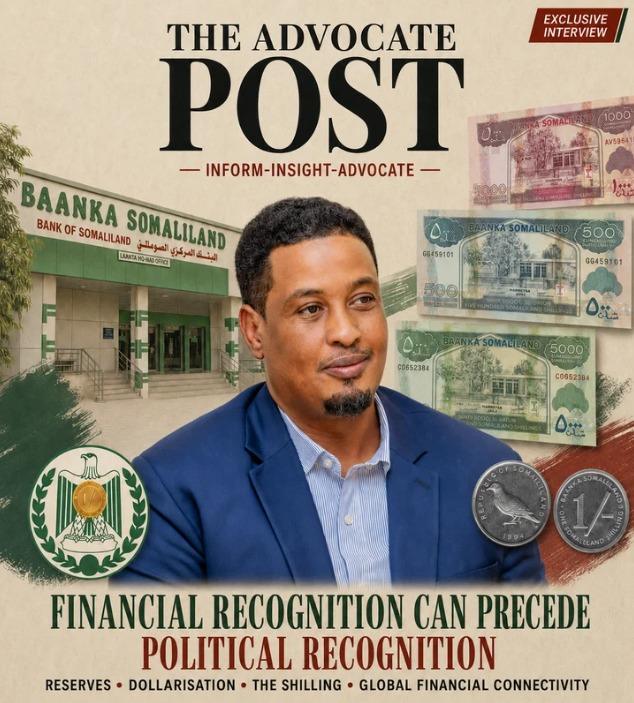
Somaliland’s central bank leadership is seeking to turn institutional credibility into practical international financial access while wider political recognition remains limited. The strategy rests on stronger compliance, transparent reserve governance, modern payment infrastructure and confidence in the Somaliland shilling.
In this Exclusive in-person interview with The Advocate Post, Bank of Somaliland Deputy Governor Hamse Abdirahman Khaire argues that financial recognition can advance through correspondent-banking relationships, bilateral central-bank cooperation, interoperable payments and stronger anti-money-laundering and counter-terrorist-financing controls.
Khaire also confirms that the Bank is studying the future of Somaliland’s currency, says a commemorative banknote or coin deserves serious consideration, supports a formal coordination mechanism with the National Insurance Authority and endorses the complete separation of commercial banking from the Bank’s regulatory and monetary functions. On national reserves, however, he declines to provide an unaudited figure and says any public disclosure must distinguish usable Bank reserves from foreign currency held for the Government.
Q1: Can financial recognition precede wider political recognition? What measurable progress should the public expect by 2028?
Yes. Political recognition and financial credibility are related, but they are not necessarily the same process. Somaliland has operated its own monetary and financial institutions for more than three decades. Our objective is to make those institutions increasingly credible, transparent, internationally compatible and professionally regulated.
Financial recognition can develop through practical relationships: correspondent banking, bilateral central-bank cooperation, stronger AML/CFT systems, interoperable payment infrastructure and greater confidence among international financial institutions.
By 2028, I would like the public to see measurable progress in at least three areas: expanded correspondent-banking relationships, greater international connectivity for our payment system and stronger institutional cooperation with regional and international financial authorities.
Our message is simple: we want Somaliland’s financial system to be judged by the quality of its institutions and the confidence it generates.
Q2: How much does Somaliland actually hold in national foreign-exchange reserves, and when will the Bank publish an audited figure?
The question of reserves must be answered with precision. The Bank distinguishes between its own usable foreign-exchange reserves and foreign currency belonging to the Government or held for specific government purposes. Those categories should not be mixed.
I therefore do not want to give the public a figure that is not properly reconciled and audited. The Bank’s objective is to establish a much clearer reserve-reporting framework showing ownership, composition, custodianship, liquidity and any encumbrances.
We are moving towards greater transparency in this area. Once the relevant reconciliation and verification processes are completed, publishing a properly defined reserve position is preferable to publishing a number that can be misunderstood.
Reserve adequacy is not simply about having a large dollar figure. It is about usable, liquid and properly governed reserves relative to the country’s external needs.
Q3: Will the Bank introduce a legally binding reserve target or a minimum level of import cover?
We support the principle of stronger reserve adequacy.
However, Somaliland’s monetary circumstances differ from those of a conventional fixed-currency or currency-board system. A reserve requirement must therefore be designed around our actual monetary structure, foreign-exchange market and fiscal environment.
I would support establishing a clear reserve-adequacy framework, including a minimum strategic threshold and a target for progressively increasing import coverage.
The objective should be to build reserves sustainably – not by restricting essential imports or remittances, but through stronger exports, improved financial-sector development, disciplined fiscal policy, better foreign-exchange management and increased confidence in the formal financial system.
Ultimately, reserve accumulation must become a national macroeconomic policy, not simply a responsibility of the Central Bank.
Q4: With the US dollar and Somaliland shilling both widely used, what is the Bank’s ultimate policy on dollarisation?
Our policy is not to create an artificial confrontation between the dollar and the Somaliland shilling. The economy has developed with significant use of both currencies. Any attempt to eliminate dollar usage overnight could undermine confidence and create unnecessary economic disruption. Our approach should therefore be gradual and market-based.
The Somaliland shilling should increasingly become the preferred currency for domestic transactions, government payments, taxation and local economic activity. At the same time, we recognise the legitimate role of the dollar in international trade, remittances, savings and certain large transactions.
The long-term objective is a stronger shilling – not a forced transition. People will use the shilling more when they are confident that it will retain value, can be exchanged easily and is supported by a reliable financial system.
Q5: What exactly is Somaliland’s exchange-rate regime: a peg, a managed band, a crawling adjustment or a reference rate?
The published exchange rate should not be interpreted simply as an arbitrary administrative number. The Bank’s responsibility is to maintain orderly foreign-exchange conditions and reduce excessive volatility while taking account of market conditions, inflation, reserves and the broader economy. We also recognise that businesses need predictability.
One of our institutional priorities is therefore to improve communication around exchange-rate policy. The public and private sectors should understand more clearly the factors influencing the Bank’s decisions without compromising its ability to intervene when necessary. I would also like to see better statistical and market information available to importers, exporters, banks and investors.
Q6: Can the Central Bank say ‘no’ to the Government where financing or intervention would threaten price stability, reserves or the currency?
A credible central bank must be able to provide independent professional advice. The Government and the Central Bank have different responsibilities, but they share a common national objective: economic stability. Fiscal and monetary policy cannot operate in isolation.
We therefore need a formal framework for fiscal-monetary coordination that ensures government financing decisions do not undermine price stability, reserve adequacy or confidence in the currency. Where a proposed policy creates serious monetary risks, the Bank must be able to communicate those risks clearly and, within the law, protect its monetary mandate. Central-bank independence does not mean institutional confrontation with the Government. It means professional discipline and clear responsibilities.
Q7: The Bank’s 2025 Annual Report cites USD 70.8 million supplied to khat importers. What justified that allocation, and how was it administered?
Foreign-exchange allocation must be understood within the wider structure of Somaliland’s economy. The Bank’s role is not to decide which private businesses deserve foreign currency on the basis of subjective preferences. Its responsibility is to manage the foreign-exchange market and support orderly economic activity within the framework of applicable regulations.
The figure cited in the question is drawn from the Bank’s 2025 Annual Report and should therefore be understood in that institutional context.
At the same time, I agree with the underlying policy question: when foreign exchange is scarce, Somaliland must continually examine whether the allocation of foreign currency supports the country’s long-term economic interests.
That means improving transparency and market mechanisms while ensuring that essential sectors – including food, medicine, energy and productive exports – have appropriate access to foreign exchange.

Q8: Is Somaliland preparing a major currency reform involving higher denominations, polymer notes, coins or redenomination?
We are studying the future of the currency as part of a broader modernisation programme. The fact that the exchange-rate denomination has reached five-digit levels creates practical challenges for cash transactions, accounting and payment systems. But denomination alone does not determine the strength of a currency.
Any decision involving new banknotes, higher denominations, coins, polymer notes or redenomination must be based on technical studies, cost-benefit analysis, security considerations and monetary conditions.
We must also communicate carefully with the public. A currency-modernisation programme should be presented as institutional and technological modernisation, not as an admission of monetary failure.
Q9: Will Somaliland issue a commemorative banknote or coin to mark its national history and monetary sovereignty?
It is an interesting proposal, and it deserves serious consideration. A commemorative issue could provide an opportunity to combine modern security features with Somaliland’s history, culture, constitutional development and economic aspirations.
However, such an initiative must be economically and technically justified. It should not create unnecessary monetary expansion or impose excessive costs on the financial system.
If the Bank proceeds, I would favour a design process involving historians, artists, security experts and the wider public while ensuring that the final currency reflects Somaliland’s identity with dignity.
Somaliland’s 35th anniversary provides a meaningful opportunity to consider such an initiative.
Q10: Will digital payments strengthen the Somaliland shilling or deepen dollarisation, and is a digital shilling under consideration?
Digitalisation itself is neither pro-shilling nor pro-dollar. The currency in which the digital ecosystem settles will determine much of the outcome. Our priority is therefore interoperability. Somaliland needs national payment infrastructure that allows banks and licensed mobile-money providers to communicate securely and efficiently.
Customers should be able to transfer money conveniently between regulated institutions and, where permitted by the regulatory framework, transact in both US dollars and Somaliland shillings. The planned national switch and instant-payment infrastructure are important parts of this transformation.
As for a central-bank digital currency, we should not introduce technology simply because it is fashionable. We first need to strengthen the existing regulated electronic-money and payment infrastructure. A digital shilling can remain an area for research and assessment as the technology and regulatory environment develop.
Q11: Can Somaliland secure SWIFT and correspondent-banking connectivity despite the constraints created by its political status?
Political circumstances create challenges, but they do not remove the importance of meeting international financial standards. Our immediate priority is not to treat SWIFT access as a symbolic objective. It is to build the institutional conditions that international correspondent banks and payment networks require.
That includes strong AML/CFT supervision, beneficial-ownership transparency, effective sanctions screening, stronger supervision of foreign-exchange businesses, appropriate reporting mechanisms and effective enforcement.
The counterfeit-currency seizures referenced in the question also demonstrate why strong financial controls matter. If we meet the relevant technical and compliance standards, we strengthen our case for international connectivity.
Our strategy is therefore to build a system that international financial institutions can trust and then pursue connectivity from a position of institutional strength.
Q12: What happens if a Somaliland bank or mobile-money operator fails tomorrow? When will deposit-protection and resolution rules be operational?
Financial stability requires a credible safety net. We are therefore committed to strengthening the legal and institutional framework for deposit protection, bank resolution and customer protection.
The framework should clearly establish who is protected, what the coverage limit is, how the fund is financed, how a failed institution is resolved and how quickly eligible customers can receive compensation.
The development of deposit insurance must also take account of the reality that Somaliland’s financial ecosystem includes banks, mobile-money providers and remittance businesses. The public should not have to discover the rules after a financial institution fails. The rules need to be established, communicated and tested beforehand.
Q13: As the Somaliland National Insurance Authority advances new regulations, how will the Bank facilitate and coordinate with the insurance regulator?
The emergence of a dedicated insurance regulator is an important development for Somaliland’s financial system. The Bank and the Somaliland National Insurance Authority should have clearly defined responsibilities while cooperating in areas where the banking and insurance sectors overlap.
I support establishing a formal coordination mechanism covering AML/CFT, regulatory information, payment systems, investment of insurance funds, bancassurance, digital premium and claims payments, and crisis management.
There is also an opportunity to develop Sharia-compliant investment instruments that allow insurance and takaful funds to invest safely in Somaliland’s productive economy. This must always be done within appropriate risk-management and solvency requirements.
The principle should be simple: cooperation between regulators without compromising regulatory independence.
Q14: When will commercial banking be completely separated from the Bank’s regulatory and monetary functions?
Separating commercial activities from the Central Bank’s regulatory and monetary functions is a major institutional reform, and I support completing it in a disciplined and transparent manner.
The reason is fundamental: a central bank should not simultaneously be the regulator, monetary authority and a commercial competitor to the institutions it supervises.
The reform programme involving KPMG and AlHuda is intended to address precisely this institutional issue. The transition must deal carefully with assets, liabilities, government accounts, employees, systems and governance.
Until the separation is completed, the Bank must maintain strong internal controls and clear institutional firewalls to minimise conflicts of interest.
The end result should be a more independent regulator and a more level playing field for commercial banks.
Q15: By what single measurable result should the public judge your tenure in 2028?
We would prefer to be judged by measurable outcomes rather than speeches.
One of the most important weaknesses in Somaliland’s financial system is limited access to formal credit. The survey figure cited by The Advocate Post – only 9 percent of respondents having obtained a loan – illustrates the scale of the challenge.
By 2028, we would want the public to judge our tenure against a small number of measurable indicators:
Greater financial inclusion and access to finance;
Improved productive-sector lending to SMEs, agriculture, livestock and manufacturing;
- Stronger foreign-exchange reserve adequacy;
- Greater use of and confidence in the Somaliland shilling;
- A more interoperable and efficient national payment system; and
- Stronger financial-sector regulation and consumer protection.
- If I had to choose one headline measure, however, I would choose access to productive finance.
A financial system should ultimately serve the real economy. If we can successfully move more savings and remittances into businesses, agriculture, livestock, manufacturing and SMEs – while maintaining monetary and financial stability – that would be one of the clearest measures of whether we have succeeded.
About the Interviewer: Abdul Rafay Afzal is a lawyer, international journalist, and Founder & Editor-in-Chief of The Advocate Post. He writes on geopolitics, international relations, legal affairs and public policy. He also serves as President (Youth) of the Civil Society Network Pakistan and Consultant for International Cooperation and Media Diplomacy at Lahore Press Club. He can be reached at abdulrafayafzal@theadvocatepost.org.
Disclaimer:
The views expressed in this interview are those of the interviewee and do not necessarily reflect the editorial position of The Advocate Post. Historical references and personal recollections have been presented as shared by the interviewee.
Editorial Insight:
Somaliland’s pursuit of financial credibility may prove as consequential as its diplomatic campaign for political recognition. In this interview, Mr. Hamse Abdirahman Khaire examines the monetary choices shaping that journey—from reserve management and dollarisation to strengthening the Somaliland shilling, developing a regulated insurance sector and connecting with regional and global financial systems.