By Nkululeko Xaba (South Africa)
South Africa often speaks of democracy as a clean constitutional break from apartheid. In law, that break was profound. In policing culture, it was far less complete. The uniforms changed, the name changed, the Constitution changed, but for many black communities the deeper experience of policing did not transform at the pace democracy demanded. Fear survived the transition.
During apartheid, the South African Police were not simply crime-fighters. They were instruments of political control. They enforced pass laws, crushed dissent, terrorised black communities, and became synonymous with humiliation, torture, arbitrary arrest, and unlawful killing. In many townships, the police were not regarded as protectors of public order but as armed guardians of racial domination. That legacy mattered because it produced not only physical violence, but also a social psychology of distrust. Communities learned to fear the police, avoid the police, and in some cases treat anyone associated with them as a collaborator with oppression.
The tragedy of post-1994 South Africa is not that democracy failed to change the law. It did. The tragedy is that the democratic state did not sufficiently reconstruct the moral relationship between the police and the people. South Africa inherited a police institution shaped by authoritarian reflexes, but it did not invest enough in replacing that culture with a deeply rooted ethos of public service, constitutional restraint, and community legitimacy. As a result, the South African Police Service entered the democratic era carrying too much of apartheid’s operational DNA.
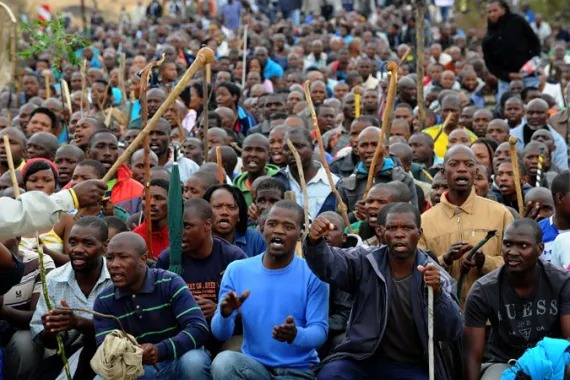
This is why the continuity is so disturbing. Under apartheid, massacres such as Sharpeville, Soweto, and Uitenhage became defining symbols of police violence against civilians. In democratic South Africa, one would have expected a decisive repudiation of that history, not only in rhetoric but in practice. Yet the killing of Andries Tatane during a service delivery protest and the Marikana massacre in 2012 exposed a more painful reality: the state had not fully broken with the logic that treats public disorder as a threat to be crushed rather than a grievance to be managed within a constitutional order.
The same continuity appears in another dark area: the persistence of extra-legal violence within police structures. Apartheid policing produced death squads, covert hit operations, and a mentality in which the elimination of “enemies” was normalised. Decades later, democratic South Africa was confronted with allegations surrounding the Cato Manor unit, where police officers were accused of murder, attempted murder, and other serious crimes. The comparison is not meant to erase historical differences between apartheid and democracy. The constitutional order today is fundamentally different. But it would be intellectually dishonest to ignore that certain violent institutional habits have proven remarkably durable.
Perhaps most troubling is the political language that has surrounded policing in democratic South Africa. Repeated calls by senior officials to “shoot to kill” are not careless slogans; they are ideological signals. They communicate to police officers that violence can stand in for lawful authority. They blur the line between law enforcement and vengeance. They reduce constitutional policing to a crude performance of force. In a country whose legal order rejected the death penalty in S v Makwanyane, such rhetoric is not only irresponsible. It is profoundly incompatible with the spirit of constitutional democracy.
This is where the central confusion in South African public life must be confronted. Police brutality is too often marketed as toughness on crime. It is not. It is institutional weakness masquerading as strength. A state confident in its legal system does not encourage vague, performative lethality. It trains professional officers, builds forensic capacity, improves prosecution, strengthens accountability, and earns public trust. When political leaders glorify violent policing, they do not solve crime; they deepen the fracture between citizens and the state.
South Africa cannot build safety on the psychological foundations of apartheid. A police service that remains feared rather than trusted will always struggle to secure cooperation from communities most affected by crime. Intelligence dries up. Witnesses stay silent. Victims disengage. And the cycle of alienation continues.
The real democratic challenge, then, is not merely to condemn apartheid-era brutality as history. It is to recognise how parts of its logic still echo in the present. South Africa needs more than police reform as bureaucratic language. It needs a constitutional re-imagining of policing itself: less militarised, more accountable, more community-based, and more firmly anchored in human dignity.
Until that happens, the country will remain trapped in a dangerous illusion that violence by the police proves the state is in control, when in fact it often proves the opposite.