
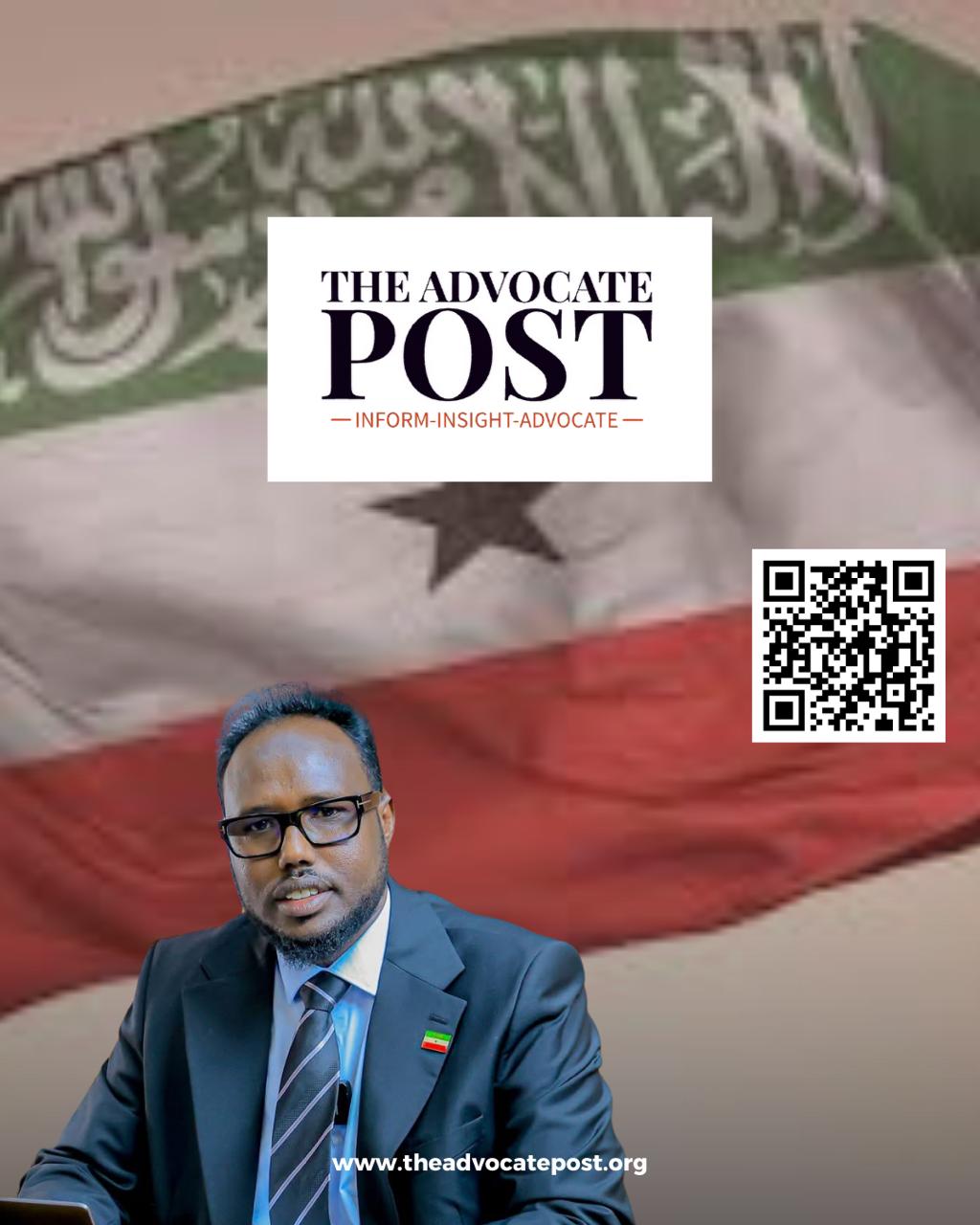
Why Somaliland’s Recognition Matters: Seeing Reality as It Is, Not as We Wish It to Be
By: H.E. Eng. Ahmed Jama Barre (Minister of Energy and Minerals, Somaliland)
To the Somalilanders, the focus on recognition is not a form of abstract diplomacy. It is heart-felt, very personal and very much needed. In the recent past, especially the accolade by Israel as the first United Nations member state to officially recognize the sovereignty of Somaliland has been celebrated by many, challenged by a few and condemned by others outside our borders.
Every one of these responses has the right to be voiced. Yet they must be placed into context since the story of Somaliland is one that the world has not wished to see.
Somaliland did not get to this place overnight, or without purpose. Somaliland is a self-governing, democratic 34-year-old peaceful state. In the same time Somalia, though still asserting its control has had no political, military, or administrative control over Somaliland. Not rhetoric but actual life.
We have our own forces protecting our borders. Our people are the ones who elect our leaders. Although it is not perfect, our institutions operate and benefit society. Where Mogadisho is weak, Hargeisa is strong. Hargeisa has a democratic politics where the democratic governance has failed elsewhere. Our towns of Burao, Borama, Berbera, Erigavo are quiet and governed by their own institutions of Somaliland. This peace, stability, and development did not come in. They were constructed with great difficulty by Somalilanders themselves.
Someday before it was even conceivable, Somaliland decided the way to revenge was reconciliation. We pacified clan militias. We held conferences of elders, intellectuals, and political leaders several months at a time, in Borama to build a modern and democratic state based on consensus, not coercion. This was not overseen by foreign forces. It was not run by international trustees. It was local, very Somali and very successful.
Somaliland was knocking on every door for over three decades. We have called on Muslim brother countries, on the countries in the region, to the African Union, and to the United Nations. We did not seek charity, but recognition of facts on the ground. We requested the world to see stability where we are encircled by instability, democracy where we have chaos and peace where we have conflict.
Those doors were kept mostly closed.
Not in failure in Somaliland, but in acknowledging Somaliland bravery, sincerity, readiness to defy inherited surmise about the Horn of Africa was needed. It is against this backdrop that new acknowledgement should be viewed. Critics have to ask themselves why not sooner but why later once one UN member state finally declared and before that our friend Taiwan, We see you.
Where was the global indignation when Somaliland managed to succeed without noise and help unlike when others failed on billions of dollars of aid? Where was the appreciation when elections had been conducted devoid of foreign troops? When were externally unsupervised institutions constructed? In peace and the flames, the region burnt?
Recognition is not betrayal. It is not desperation. It is the logical consequence of endurance.
Certainly, some Somalilanders are quite understandably uncertain. This is what I would tell them: we are not selling our identity, our faith, our values, and our sovereignty. The alliances that Somaliland has are not at the cost of its values. Islam is not just a component of our culture; it is a kind of constitutionally guaranteed state religion. The Shahadah is a visible sign of our national flag. There is no consensus, present or absent, which undermines this corner.
Misinformation very recently such as the rumor of the Palestinian being relocated to Somaliland or that the recognition is compromising our Islamic values is not true and is damaging. These are not issues that were ever discussed. These kinds of narratives are aimed at instilling fear where there are certainty and trust.
I can observe with my own eyes what recognition can open not only diplomatically, but also materially, as the Minister of Energy and Minerals. The identification facilitates the entry to responsible investment, open partnerships, energy development, job creation, and integration of the economies. They are not the ambitions of the elite; they are the needs of a young and enterprising population already tested in their strength.
However, recognition is not a goal. It is a responsibility. The government of Somaliland realizes that sovereignty should be accompanied by better governance, increased institutions and development equity. Systemic weaknesses need to be addressed to ensure every Somalilander enjoys future opportunities.
To the world, especially the accusers of this time. My humble, yet assertive request is to see Somaliland the way it is, and not the way old maps would like it to be. The 34-year delayed engagement should not be turned into engagement denied.
It has nothing to do with rewriting the history or taking sides. It is concerning matching international policy to reality.
It was not Somaliland that demanded to be exceptional. It became so by necessity. Sonialiland was not created by the world; it was formed by itself. Recognition is merely the recognition of what has been the case.Should the international community really believe in peace and democracy and self-determination, time has come to stand with Somaliland not because one nation has done it, but because Somaliland has deserved its niche within the world of nations.
The ability to learn and accept successful realities is the future of the Horn of Africa rather than denying it.
By: H.E. Eng. Ahmed Jama Barre
About the Author: Author is from Somaliland, currently serving as the Minister for Energy and Minerals, Republic of Somaliland.

This Post Has One Comment
Pingback: Somaliland, Somalia, Sudan And Yemen: When Regional Rivalries Become Local Crises | Qaran News