

By Abdul Rafay Afzal (Editor in Chief – The Advocate Post)
“Recognition Will Not Create a State, It Will Only Acknowledge One”
Hon. Yasin Haji Mohamoud “Faratoon” is the Speaker of the House of Representatives of the Republic of Somaliland (de facto), a veteran statesman, senior political leader, and one of the country’s most influential architects of parliamentary diplomacy. With decades of service including multiple high-level ministerial roles, he has played a central part in Somaliland’s democratic evolution, institutional development, and regional engagement. As Speaker, he oversees one of the Horn of Africa’s most active and resilient legislative bodies, an institution that has sustained multi-party politics, peaceful transitions of power, and credible elections despite the region’s volatility.
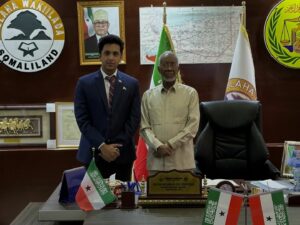
Earlier this year, Abdul Rafay Afzal, Editor-in-Chief of The Advocate Post, conducted an official visit to Somaliland, during which he met Speaker Faratoon at the Parliament in Hargeisa. During their meeting, the Speaker granted an exclusive in-office interview to The Advocate Post, offering rare insights into Somaliland’s democratic identity, its diplomatic strategy, and its vision for international cooperation.
Executive Summary
Speaker Yasin Haji Mohamoud “Faratoon” discusses Somaliland’s democratic resilience, its long-running quest for international recognition, and the priorities of the current Parliament. He highlights Somaliland’s distinction as the most stable democratic system in the Horn of Africa and stresses that the country already meets all international criteria for statehood. The Speaker also outlines Parliament’s focus on institutional reforms, responsible resource management, and expanding inter-parliamentary diplomacy. Speaking on foreign relations, he expresses openness to deeper engagement with Pakistan and welcomes future cooperation with its federal and provincial assemblies. He concludes by reaffirming Somaliland’s commitment to peace, governance, and meaningful global partnerships.
Q1: Somaliland has often been described by observers as a “democratic outlier” in the Horn of Africa. From your vantage point, what has allowed Somaliland to maintain electoral integrity and political stability when the region remains volatile?
Faratoon: Somaliland’s democratic success is rooted in our people. Elections here are not an imported model but a product of local consensus and political maturity. We have held competitive and peaceful elections while many in the region have struggled. Our institutions may not be perfect, but they function independently and with legitimacy. That is the foundation of our stability.
Q2: For over three decades Somaliland has pursued international recognition. What is the current diplomatic strategy of the Parliament, especially in light of shifting geopolitical interests in the Red Sea and Horn of Africa?
Faratoon: Our outreach has been consistent for years with African states, regional blocs, Europe, and the United States. Many actors privately acknowledge our legal and historical legitimacy. The obstacle is geopolitical, not legal.
But as the region’s strategic importance grows, so does Somaliland’s relevance. We believe that international recognition will eventually align with regional stability and global interests. I must say that “Recognition Will Not Create a State It Will Only Acknowledge One”
Q3: International law experts frequently cite Somaliland as one of the strongest contemporary cases for statehood under the Montevideo Convention. Do you believe global institutions are prepared to revisit this conversation?
Faratoon: Yes, We meet every criterion of statehood territory, population, functioning government, and capacity to engage internationally.
But global institutions often move slowly. The argument is not about legality anymore; it is about political will. Eventually, the international community will have to reconcile principles with reality.
Q4: With a new political administration and Waddani’s first national mandate, how is the legislative agenda shifting? Are there particular reforms you are prioritizing as Speaker?
Faratoon: Our focus is institutional modernization strengthening oversight, refining economic governance, reforming outdated laws, enabling decentralization, and increasing parliamentary transparency. The agenda is more ambitious, and Parliament is committed to supporting reforms that produce tangible benefits for citizens.
Q5: Somaliland’s Parliament has increasingly engaged in inter-parliamentary diplomacy. What strategic value do you see in building alliances with foreign legislatures?
Faratoon: Parliaments are guardians of democratic legitimacy. Engaging with them enhances our international visibility, strengthens our institutional expertise, and expands our diplomatic footprint even without formal recognition. We already cooperate with several African and European legislatures, and we plan to broaden this network significantly.
Q6: Is Somaliland moving toward active participation even at observer level in global parliamentary forums such as the Inter-Parliamentary Union, African parliamentary platforms, or transnational democracy initiatives?
Faratoon: Yes, this is a central ambition. Even observer status allows us to present our democratic credentials and learn from international best practices. These platforms facilitate dialogue and raise awareness of Somaliland’s achievements and aspirations.
Q7: With the global spotlight shifting to Somaliland’s mineral wealth and the upcoming Minerals Expo 2025, what principles guide Parliament’s oversight of the extractive sector?
Faratoon: Our priority is responsible resource governance. We are committed to transparency, environmental protection, fair revenue distribution, and ensuring that foreign partnerships align with national interest.
Resources must uplift our people, not create dependency or corruption. Parliament’s role is to safeguard this and we are doing it affectively.
Q8: Somaliland’s diplomatic and economic footprint is expanding beyond Africa. How do you see potential partnerships with South Asia, particularly Pakistan, shaping future cooperation?
Faratoon: Pakistan is important to us. Their community here contributes to our economy and very active in our national celebrations and contributes positively.
We see potential in trade, education, medical cooperation, and parliamentary dialogue etc.
We welcome structured engagement whether directly with federal institutions or with provincial assemblies such as Punjab, Sindh or others.
Q9: Finally, what message would you send to the international community observing Somaliland’s journey from conflict recovery to democratic consolidation?
Faratoon: Somaliland is peaceful, democratic, and self-governing. We built institutions without foreign intervention, maintained security in a turbulent region, and demonstrated political maturity.
Recognition will not create a state it will simply affirm the one that already exists, built by the will and sacrifice of its people.
Editor’s Insight:
This interview offers a rare window into the strategic thinking of Somaliland’s parliamentary leadership at a time when regional politics, resource interests, and governance models in the Horn of Africa are undergoing rapid change. Speaker Faratoon’s remarks reveal a blend of confidence, diplomatic realism, and institutional vision reflecting Somaliland’s self-built democratic trajectory and its aspiration to engage globally despite the absence of formal recognition. For observers of African politics, emerging democracies, and de facto states, his perspectives provide valuable clarity on how Somaliland sees itself and how it aims to position its institutions in the international system.
Disclaimer:
This interview was recorded during the official visit of Abdul Rafay Afzal, Editor-in-Chief of The Advocate Post, to Somaliland. The views expressed by Speaker Yasin Haji Mohamoud “Faratoon” are his own and do not necessarily represent the official policy of The Advocate Post or any affiliated institution. Quotes have been edited for clarity and coherence while preserving their original meaning. The Advocate Post maintains full editorial independence and accuracy standards in presenting this content.
Abdul Rafay Afzal is the Editor in Chief of The Advocate Post, recognised as Pakistan’s youngest international journalist. He writes perceptive columns on geopolitics, international relations, and legal affairs etc. in more than 15 countries. Moreover he is a lawyer, global affairs & policy advisor, President (Youth) Civil Society Network Pakistan and Consutant (International Cooperation and Media Diplomacy) Lahore Press Club. He can be reached at @arafzal555 on instagram or email abdulrafayafzal@theadvocatepost.org